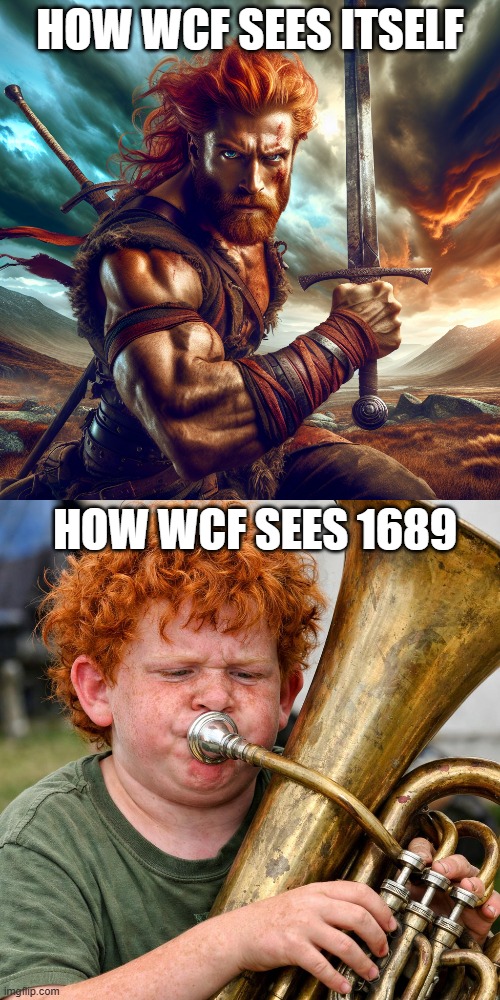
This still seems to be the case to some extent. Given the nature of so many of the exchanges and attitudes on the PB, I sometimes wonder if everyone would be better off if the PB were to be made solely the haunt and echo-chamber for the vast majority of paedobaptists here. It does get tiring sometimes being talked about and treated like a reluctantly put-up-with red-headed country-cousin stepchild - despite a shared belief in the doctrines of grace. But then again, that isn't really necessary, as folks are free to stop participating at any time...
Over on another thread,
@davejonescue has reminded us non-Baptists that the total number of evangelical Baptists in America vastly exceeds all liberal, moderate, and conservative Presbyterian and Reformed paedobaptists, even if we include the PC(USA)'s inflated numbers of non-attending supposed "members" in churches that aren't anywhere close to being Reformed or even teach basic biblical doctrine.
I've been listening for years to Dr. R. Scott Clark over on the Heidelblog arguing that "Reformed Baptist" is a contradiction in terms, and long before Dr. Clark was teaching at Westminster, I was listening to Dutch Reformed people arguing that anyone who doesn't practice infant baptism has fundamentally departed from covenant theology and is no longer entitled to be called "Reformed." (To be fair to him, Dr. Clark is being faithful to his own theological tradition, originally that of the German Reformed and now of a significant part of the Dutch Reformed tradition, and I don't blame him for that. I disagree, and he knows that.) Many other people could be cited, including a Calvin Seminary professor who seriously argues that the Five Points are not enough and we need to elevate both infant baptism and presbyterian church government (but apparently not male gender for presbyters) to mandatory requirements to be called "Reformed."
I've been disagreeing on that all way back to the 1980s. I believe Reformed Baptists are our brothers in sovereign grace. In return, I've not only been called "reductionist" in my view of what it means to be Reformed, I've been told that I'm a "pietist" who places personal conversion above the covenant.
To that second accusation, I plead guilty. That's what it means to be Puritan. People who emphasize the covenant instead of conversion are the people who opposed the Puritans four centuries ago, and I'll make my stand on the absolute necessity of personal conversion.
There are reasons why John Owen worked hard, at considerable personal risk, to get John Bunyan out of prison and to get Pilgrim's Progress published. A shared commitment to Puritan theology of personal conversion was high on the list of those reasons.
The road that some of the extreme anti-Baptists want to take ends badly in narrowness and bitterness between people who should be brothers, and allowing our enemies to take a divide-and-conquer approach to attack us all.
Since I mentioned Dr. Clark by name, I need to make clear that I don't include him in that "extreme anti-Baptist" category. He has a different set of confessions from the WCF in which the Belgic Confession takes a far harder line than the WCF, and even before he joined the URC, he came from a different theological tradition, the German Reformed, that was not only firmly opposed to "revivalism" and the Second Great Awakening, but also deeply suspicious of the Puritan project and the First Great Awakening under Jonathan Edwards, et al. Dr. Clark's views are within the mainstream of the historic Dutch Reformed position, and he's said repeatedly that Reformed Baptists should call themselves "Particular Baptists," not "Reformed," and would respect them if they maintained their own Particular Baptist tradition without calling it "Reformed." I disagree with him, but that's kind of like telling a member of a Reformed Episcopal church that he shouldn't have bishops or telling a Covenanter that predominant psalmody is good but churches don't need to practice exclusive psalmody. His views are part-and-parcel of his theological tradition and I don't object to people following their own confessions and their theological tradition's historic interpretation of their confessions.