So I was reading Pratt's Taking Every Thought Captive. This question arose in my mind- so say , I'm showing the unbeliever his self-contradictory dilemma of absolute certainty(but he can't know anything for certain) and absolute uncertainty(he can't know that for certain) and what if the unbeliever asks if the same could be said about the Christian faith. "Are you sure about what you believe just because you do/just because God has revealed it to you" I remember Bahnsen or somebody saying that all arguments are circular - the Christian's being virtuous rather than vicious; But is there a practical way in which I could respond to this objection?


Navigation
Install the app
How to install the app on iOS
Follow along with the video below to see how to install our site as a web app on your home screen.
Note: This feature may not be available in some browsers.
More options
You are using an out of date browser. It may not display this or other websites correctly.
You should upgrade or use an alternative browser.
You should upgrade or use an alternative browser.
Doubt in presuppositionalism
- Thread starter Henoch
- Start date
- Status
- Not open for further replies.

Polanus1561
Puritan Board Senior
why is a Yes not sufficient here? Isn’t it just a question and not an objection?
Ah right! A yes is indeed sufficient! I should have put it more clearly,why is a Yes not sufficient here? Isn’t it just a question and not an objection?
I meant like what if the question is how do you know for sure if God has revealed these things to you and you're not arbitrarily imagining that to be the case?
Polanus1561
Puritan Board Senior
You make a jump to a “possible” imagining of things without taking into account the vital role of the Scriptures that we, you, I hold.Ah right! A yes is indeed sufficient! I should have put it more clearly,
I meant like what if the question is how do you know for sure if God has revealed these things to you and you're not arbitrarily imagining that to be the case?
The King has spoken to us in a written Word whereby as the confession says, the Spirit helps us see the inherent glory of this word.

RamistThomist
Puritanboard Assessor
So I was reading Pratt's Taking Every Thought Captive. This question arose in my mind- so say , I'm showing the unbeliever his self-contradictory dilemma of absolute certainty(but he can't know anything for certain) and absolute uncertainty(he can't know that for certain) and what if the unbeliever asks if the same could be said about the Christian faith. "Are you sure about what you believe just because you do/just because God has revealed it to you" I remember Bahnsen or somebody saying that all arguments are circular - the Christian's being virtuous rather than vicious; But is there a practical way in which I could respond to this objection?
It's not so much doubt, but a shrewd skeptic can always turn the tables and say, "If you don't presuppose ______, then you can't make sense of _____." Presuppositional Roman Catholics are really good at doing this. It might be true that all arguments are ultimately circular, but that really isn't helpful. Someone who is good at thinking on the fly can make life difficult for you.
Presup is good if one is responding to a pure Platonist, or a pure Heraclitean, or a pure Humean. Those people cannot make sense of unity and particularity. It's much more complicated when you come across a person who isn't a pure specimen of a single instance of philosophy.

Ed Walsh
Puritan Board Graduate
I meant like what if the question is how do you know for sure if God has revealed these things to you and you're not arbitrarily imagining that to be the case?
Greetings,
I may be misunderstanding the question. Forgive me if that's the case. But is not the answer simply that God has revealed it to us, and that infallibly so. Who cares if an unbeliever walks away laughing at you. You have given the correct answer and discharged a large part of your duty.
I'll stop here and I'm sure if I'm off base somebody will tell me.
Westminster Confession of Faith, chapter one, Of the Holy Scripture
IV. The authority of the holy scripture, for which it ought to be believed and obeyed, dependeth not upon the testimony of any man or church, but wholly upon God, (who is truth itself,) the author thereof: and therefore it is to be received, because it is the word of God.
V. We may be moved and induced by the testimony of the Church to a high and reverend esteem of the holy scripture, and the heavenliness of the matter, the efficacy of the doctrine, the majesty of the style, the consent of all the parts, the scope of the whole, (which is to give all glory to God,) the full discovery it makes of the only way of man’s salvation, the many other incomparable excellencies, and the entire perfection thereof, are arguments whereby it doth abundantly evidence itself to be the word of God; yet, notwithstanding, our full persuasion and assurance of the infallible truth, and divine authority thereof, is from the inward work of the Holy Spirit, bearing witness by and with the word in our hearts.
Makes sense! Thank you!!!!You make a jump to a “possible” imagining of things without taking into account the vital role of the Scriptures that we, you, I hold.
The King has spoken to us in a written Word whereby as the confession says, the Spirit helps us see the inherent glory of this word.

jwright82
Puritan Board Professor
Yeah, where does the certainty lie? Certainty can be empirical, my head hurts because a board just dropped on it, or 2 + 2=4. But a greater certainly exists for the Creator's perspective, obviously if God says something is such and such than it is. Now showing that is different, gauging where the person is will determine the best course of action.So I was reading Pratt's Taking Every Thought Captive. This question arose in my mind- so say , I'm showing the unbeliever his self-contradictory dilemma of absolute certainty(but he can't know anything for certain) and absolute uncertainty(he can't know that for certain) and what if the unbeliever asks if the same could be said about the Christian faith. "Are you sure about what you believe just because you do/just because God has revealed it to you" I remember Bahnsen or somebody saying that all arguments are circular - the Christian's being virtuous rather than vicious; But is there a practical way in which I could respond to this objection?
If it's evidence for reliability of scripture then start there but it may be deeper than that, intellectually.
But the general trajectory is the same in method. Start where they are and then you may have to adjust where you are on the line of method to move forward or backwards on the line. If they agree on basic issues but doubt one thing, the historical reliability of the Gospels say, than you shouldn't have to go through assumptions and such. Just argue from facts.
It's sounds like your hypothetical skeptic is at the beginning, so let's look at where your problem lies. In your scenario you have a believer and an unbeliever standing in the same relationship to all things, as rational judges of all things.
Every fact stands equally under your shared reason to decide. You point out the futility of the ground they're standing, the vicious circular reasoning they use (to simplify things it's more complex than this) and employ your virtuous circular reasoning. Now they notice a problem (reasoning in a circle), call it what you want to but a circles a circle. Now what do you do?
Well you imagined the situation that way and you have a problem. If you imagine it a different way and the problem might go away. If I assume some standard as ultimate and seek to go out and judge all things as rational or not, than it better be an ultimate standard. If it's not, than I have a problem.
So if my ultimate standard is not ultimate than I'm either begging the question or I must find another standard more ultimate than my previous ultimate standard, and on and on to infinity. But if I start with the only ultimate standard there is God's revelation and judge all things by that standard than the problem disappears in theory.
Now, in practice, on my line of method from before I go before "facts" and attempt to show that their "ultimate standard" isn't even rational as a standard to judge everything. Once I show that and then show how everything judged by the ultimate standard of God's revelation makes sense as it is.
Sorry I missed this thread before. Does this make more sense?
I remember Bahnsen or somebody saying that all arguments are circular - the Christian's being virtuous rather than vicious; But is there a practical way in which I could respond to this objection?
How are the arguments circular? I believe in the resurrection of Jesus. My ultimate reason for believing this is the testimony of God in Scripture. I don't then turn around and say that I believe in Scripture because of the resurrection. I think what is meant is that every argument ends up being an appeal to authority when it is reduced to its basic components.

I think this is more important to consider than being committed to some sort of "school" that forces one to use only TAG-like arguments for God.How are the arguments circular? I believe in the resurrection of Jesus. My ultimate reason for believing this is the testimony of God in Scripture. I don't then turn around and say that I believe in Scripture because of the resurrection. I think what is meant is that every argument ends up being an appeal to authority when it is reduced to its basic components.
I've been listening to a recent translation into English of John Arrowsmith's Plans for Holy War.
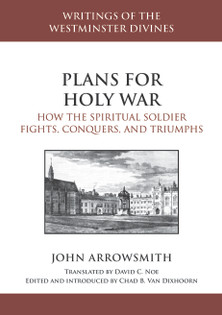
Plans for Holy War: How the Spiritual Soldier Fights, Conquers, and Triumphs (Arrowsmith)
Puritan and Reformed books at discounted prices.
 www.heritagebooks.org
He has to take on Roman Catholics, Enthusiasts, Socinians, and others. He defends Protestant and Presbyterian/Reformed convictions even as he demonstrates the folly of each school. This means that, for Roman Catholics, he has to use the matured doctrines on the nature of Scripture itself to bolster confidence in it as well as deal with the absurd ideas and superstitions that the Roman catholic Church surrounds itself with to merely assert its own authority to settle matters.
I've been listening to a recent translation into English of John Arrowsmith's Plans for Holy War.
I'm looking forward to this book. Protestants used to point out the circular reasoning involved in the RC position. They make the Scriptures dependent on the church, but they need the Scriptures to reveal the church.
Is there an audio version? It sounds like the type of book to listen to while exercising.


Ploutos
Puritan Board Graduate
It seems there's a difference between circular reasoning and a line of reasoning that traces itself back to an ultimate source, which every argument eventually has to do.
"This is a book because it has pages. How do we know it has pages? Because it's a book."
This is a crass example of a circular argument that accomplishes nothing. But our beliefs have to rest on some foundation, and at some point you have to arrive at a self-attesting or a priori truth of some sort.
"This is a book because it has pages. How do we know it has pages? Because it's a book."
This is a crass example of a circular argument that accomplishes nothing. But our beliefs have to rest on some foundation, and at some point you have to arrive at a self-attesting or a priori truth of some sort.
"This is a book because it has pages. How do we know it has pages? Because it's a book."
That doesn't really work. All books have pages but not everything that has pages is a book. It might be a newspaper.

TheInquirer
Puritan Board Junior
You can't argue an unbeliever out of his folly.
I think it is helpful to be reminded that it is the gospel that is the power of God for salvation. Some of these apologetic methods seem to assume the non-believer is actually interested in truth and somehow untangling their false beliefs through one argumentation method or another will "win them over." I understand God can use all forms of truth as a part of the process of a person's salvation, but unless the person is given the gospel, all these methods are insufficient and not God's ordained methods.
In other words, if God has ordained the preaching of the gospel to convert the elect, let's focus on preaching the gospel and not be overly concerned about answering a limitless supply of objections from the unbeliever who is darkened in mind and actively suppressing whatever truth you give them. If the Spirit of Christ is opening their hearts, it is the gospel that will shine through all the lies.
I think it is helpful to be reminded that it is the gospel that is the power of God for salvation. Some of these apologetic methods seem to assume the non-believer is actually interested in truth and somehow untangling their false beliefs through one argumentation method or another will "win them over." I understand God can use all forms of truth as a part of the process of a person's salvation, but unless the person is given the gospel, all these methods are insufficient and not God's ordained methods.
In other words, if God has ordained the preaching of the gospel to convert the elect, let's focus on preaching the gospel and not be overly concerned about answering a limitless supply of objections from the unbeliever who is darkened in mind and actively suppressing whatever truth you give them. If the Spirit of Christ is opening their hearts, it is the gospel that will shine through all the lies.
You can't argue an unbeliever out of his folly.
That is not the point of apologetics. It is to show the reasonableness of Christianity and the folly of unbelief.
The preaching of the gospel will include apologetical elements if it properly addresses the unbeliever and takes captive every thought. Compare Paul's preaching in the synagogue and on the Areopagus, Acts 13, 17.
TheInquirer
Puritan Board Junior
That is not the point of apologetics. It is to show the reasonableness of Christianity and the folly of unbelief.
The preaching of the gospel will include apologetical elements if it properly addresses the unbeliever and takes captive every thought. Compare Paul's preaching in the synagogue and on the Areopagus, Acts 13, 17.
I said - "You can't argue an unbeliever out of his folly."
You said - "That is not the point of apologetics. It is to show the reasonableness of Christianity and the folly of unbelief."
If the audience is the unbeliever, how do our two statements substantially differ?
Acts 13 - Paul is speaking to the "men of Israel" and simply recounting the story of redemption from Scripture and the fulfillment in Christ.
Acts 17 - The content of Paul's argument and reasoning with the Gentiles is "preaching Jesus and the resurrection" (17:18)
1 Corinthians 2:2 - Paul came to Corinth preaching Christ and him crucified.
I don't see how your proof texts disprove my point.
We are in a forum called apologetical methods. You have come midstream into a discussion on presuppositional apologetics. In that context you made a statement which says, "let's focus on preaching the gospel" because you can't argue an unbeliever out of his folly. My point is that you need to show the unbeliever his folly. That is the apologetical task. As for Acts 13 and 17, Paul argues according to the particular unbelief system of his audience. His preaching is different in each case. He is engaged in apologetics even while he preaches the gospel. It is not a case of one or the other.
TheInquirer
Puritan Board Junior
And my point is you can go round and round with an unbeliever on any number of issues - whose argument is circular and whose is not - and unless you give him the gospel, you have not given him the God ordained means for his salvation.
The preaching of the cross will always be folly to the unbeliever unless the Spirit of God is opening his mind, even moreso trying to get into an epistemological debate.
You may be annoyed by my interjection but others may profit from it. I would simply answer the OP's initial question with the following - If you get to such a point in your discussion with your friend, give him the gospel. If he chooses not to believe it, you do not need to worry, you have done what God has asked you to do. Pray that God would open his heart. You do not need to counter his every argument with more counter arguments. You do not need to be a master of philosophy and logic and apologetics to achieve your task as a faithful witness to Christ.
My objection is this - I have seen far too many apologists and their methods confound the simplicity and power and God-ordained means of the gospel through insisting one become a master of every possible counter argument or their preferred apologetic method against another. I do not see the evangelists of Scripture modeling such an approach. My point is to trust in the God-ordained means of bringing the elect to faith and not worry if you can't answer every argument - you simply do not need to. The Gospel and the power of the Spirit are sufficient to open the eyes of those God is saving.
Apolgies to the OP if this was a distraction - I meant it to be an encouragement to you in your discussion with your friend and to help you grow in your confidence in the power of the gospel and clarity in your role as a faithful Christian witness.
The preaching of the cross will always be folly to the unbeliever unless the Spirit of God is opening his mind, even moreso trying to get into an epistemological debate.
We are in a forum called apologetical methods. You have come midstream into a discussion on presuppositional apologetics.
You may be annoyed by my interjection but others may profit from it. I would simply answer the OP's initial question with the following - If you get to such a point in your discussion with your friend, give him the gospel. If he chooses not to believe it, you do not need to worry, you have done what God has asked you to do. Pray that God would open his heart. You do not need to counter his every argument with more counter arguments. You do not need to be a master of philosophy and logic and apologetics to achieve your task as a faithful witness to Christ.
My objection is this - I have seen far too many apologists and their methods confound the simplicity and power and God-ordained means of the gospel through insisting one become a master of every possible counter argument or their preferred apologetic method against another. I do not see the evangelists of Scripture modeling such an approach. My point is to trust in the God-ordained means of bringing the elect to faith and not worry if you can't answer every argument - you simply do not need to. The Gospel and the power of the Spirit are sufficient to open the eyes of those God is saving.
Apolgies to the OP if this was a distraction - I meant it to be an encouragement to you in your discussion with your friend and to help you grow in your confidence in the power of the gospel and clarity in your role as a faithful Christian witness.
You may be annoyed by my interjection but others may profit from it. I would simply answer the OP's initial question with the following - If you get to such a point in your discussion with your friend, give him the gospel. If he chooses not to believe it, you do not need to worry, you have done what God has asked you to do. Pray that God would open his heart. You do not need to counter his every argument with more counter arguments. You do not need to be a master of philosophy and logic and apologetics to achieve your task as a faithful witness to Christ.
I am not annoyed. I simply answered your interjection. Apologetics is not as separable from preaching the gospel as you suggest. Apologetical method is in the preaching of the gospel. Again I refer to the difference between Acts 13 and 17. Paul tailored his message. It wasn't just give them the gospel. He sought to persuade men.
If you have an iPhone, you can use Voice Dream. Reformation Heritage Books sells it in digital format (ePub). You can load the file into your Voice Dream app and listen to it while you're working out, driving, etc.I'm looking forward to this book. Protestants used to point out the circular reasoning involved in the RC position. They make the Scriptures dependent on the church, but they need the Scriptures to reveal the church.
Is there an audio version? It sounds like the type of book to listen to while exercising.
I've been using a British voice for this work. I'd use Australian, but I want it to sound intelligent.
Voice Dream also handles DOCX and PDF files. It's how I listen to all of my books. I just completed Von Maastricht's first volume this way. If the work is in Logos, I export the book 100 pages at a time using the Print/Export feature and create a large DOCX file that I then load into my Voce Dream reader.
I think the "give and take" about what role "apologetics" should play is dealt with in the method that Von Mastricht proposes in his work Theoretical Practical Theology. Focus specifically on what he notes about the need for what is called Elenctic theology. One needs to demonstrate how others who might otherwise seem to confess Christianity need to be answered and refuted as well as those who do not confess the Christian religion.
The Dogmatic Part
Theology must be taught in a certain order.
III. From what has been said, it is apparent by way of introduction, that theology must be taught according to a certain method, and it must be the kind of method in which theory and practice always walk in step together. In fact, they must walk together in such a way that theory precedes and practice follows in every one of theology’s articles. For the apostle commands Timothy (1) to teach just as much as to exhort all the heads of theology. First he should certainly teach, and then he should exhort. For this reason, (2) the covenant is spoken of as a “covenant ordered in every respect”20 (2 Sam. 23:5); not only is it called such because the covenant of grace is itself most well ordered,21 but also because its records,22 in which theology is preserved, present themselves as set down in a most suitable manner. For this reason, (3) the apostle says that the approved “worker”23 is the one who “rightly divides the Word of truth”24 (2 Tim. 2:15). But one cannot rightly divide what has not been rightly constructed. (4) The worship that theology propounds is called “reasonable”25 (Rom. 12:1) because it has been arranged according to the laws of right reason. (5) Many illustrious and remarkable examples of methodical arrangement found throughout the Scriptures argue this main point. If you want to contemplate what must be done, consider the Decalogue, which is striking for its amazing method. If you want to look for what must be petitioned, consider the Lord’s Prayer. If you want to seek what must be believed, then consider not only Hebrews 6:1–2 as a brilliant catechism, but the entire system of theology in most of the Pauline epistles. I would add (6) that the whole biblical text, without doubt, is a “covenant ordered in every respect.” And (7) since the heads of theology are scattered throughout the whole corpus of Scripture, it is surely necessary to gather and arrange them according to a suitable order and method. For this reason, (8) from the very first beginnings of the Christian church, when doctrinal heresies began to creep in, Christian theology immediately began to be arranged methodically into a system, as is evident not only in the more illustrious creeds—the Apostles’, the Nicene, the Ephesian, the Chalcedonian, and others—but also in the individual writings of the first fathers; for example, in the eight books of Clement of Alexandria’s Stromata, the four books of Origen’s On First Principles, the seven books of Lactantius’s Divine Institutes, the five books of Gregory of Nazianzus’s On Theology, the books of Augustine’s On Christian Doctrine and his Enchiridion, Rufinus’s Commentary on the Apostles’ Creed, Theodoret’s Epitome of Divine Dogma, Prosper of Aquitaine’s little book of Sentences, the four books of John of Damascus’s On the Orthodox Faith, the four books of Peter Lombard’s Sentences, and what commentators on those books have written, such as Albert the Great, Thomas Aquinas, Scotus, Bonaventure, and others; see especially Thomas Aquinas’s Summa Theologiae. And, finally, see the work of those theologians who escaped from the papacy: Zwingli, Luther, Melanchthon, Calvin, Bullinger, Musculus, Aretius, Vermigli, Ursinus, Zanchi, and a thousand others who were occupied to the utmost with rendering the heads of theology into systems.
The need for method in theology is confirmed by three reasons.
IV. In addition to the reasons from Scripture, method in theological matters is urgently demanded for the following reasons: (1) The nature of God, who, since he is not a “God of confusion,”26 has conducted and does conduct all his works in the most orderly way possible, and desires all things to be done “decently and in order”27 (1 Cor. 14:33, 40). Surely for this reason he conferred on rational creatures the principles of order and method, that he might show that he is the author of all order and method, and also that he might direct us to preserve order and method, certainly in general, but especially in matters of great importance. And without a doubt, theological matters are of this sort. To that end, he also inspired the writing of his Scriptures by amanuenses in an order according to his choice, and yet certain and logical. This order has been shown, by the logical analysis of both testaments provided by learned men, to be clearer than the sun. (2) The nature of this theology, which, since it embraces diverse dogmas scattered throughout the vast corpus of Scripture that are among themselves mutually consistent, ordered, and aiming at the same goal, certainly requires those dogmas to be collected and constructed in a manner mutually consonant with one another. Method consists in this sort of activity. (3) The benefits of this method, which, if they belong to any science, at the least belong to the most outstanding science of all. Then what is a method for? A method brings clarity to the topics that must be taught, and produces understanding when, through a knowledge of logical consequences, it makes it easy to remember since it strings together subjects as with a chain by which something may be recovered easily enough if it should drop out. Additionally, a method produces brilliance and elegance in argument. For without method, there arises, according to Philo, “knowledge without knowledge.”28 Would you have any right to deny such benefits to theological matters?29
The sort of method that must be employed is explained.
V. You might ask, by what method, then, is theology most suitably taught? A method is nothing but an apt arrangement of the different topics according to the dependence they have upon each other, first with respect to themselves in how they mutually coexist, and then with respect to us in how we understand them. This is necessary so that the method of theology corresponds not only to the topics that must be taught—by it, for example, more general matters are placed ahead of specific ones and simpler matters ahead of complex ones—but that it corresponds also to the comprehension and use of the students. At this point, different people follow a different method, which we will not criticize. We approve, out of all methods, the one that the apostle not only commends in this text to Timothy, when he wishes that theological matters first be taught and then admonished, that thereby practice be perpetually joined to theory, but also employs everywhere throughout his epistles, especially those he wrote to the Romans, Ephesians, Hebrews, and others. By this method, I say again, practice should be joined to theory, not only in the whole corpus of theology, in such a way that the first place is especially reserved for the things that must be believed and the second for the things that must be done, but also that in each member of theology, practice should walk in step with theory in a continuous agreement.30 Let me say more precisely what I desire and will pursue, God willing, to the best of my ability, namely, that the heads of theology should be (1) positively proved from the Scriptures, confirmed by reasons, and explicated in all their members, which is like a solid foundation for the entire structure; (2) elenctically vindicated against the artifices of all opponents, for without that vindication the constructed foundation neither stands sufficiently on its own nor becomes sufficiently rooted in the hearts of those who theologize;31 and (3) practically applied, without which the prior points will be entirely and plainly useless.32 For just as practice without theory is nothing, so theory without practice is empty and vain. For that reason, in his most wise counsel, the Savior joins them together: “If you know these things, you will be blessed if you do them” (John 13:17).
The Elenctic Part
Must theology be taught according to a certain method?
VI. It is asked, must theology be taught according to a certain method? As an example of excess, the Scholastics, according to their philosophical theology, loved the philosophical method of Aristotle—whether it was his analytic or synthetic method—to the point of distraction. As an example of deficiency, the Anabaptists, enthusiasts, and fanatics, due to ignorance and hatred of philosophy, reckon that all method should be eliminated from theological matters. One after another of our Reformed theologians, in proving their own points, opposed such persons. The Reformed, against the Anabaptists and enthusiasts,33 demand a method, but not, precisely speaking, a philosophical one. They demand a natural method, that is, a method that is suitable for theological matters, and for assisting the judgment and strengthening the memory—however much that method might otherwise depend on the discretion of the writer. We have previously demonstrated such a method in §§III–V, and in this method we are supported by the continual practice of the God-breathed34 Scriptures, which follow diverse methods according to the matters arising in them. The enthusiasts raise the following objections: (1) Theology surpasses the capacity of reason and thus also a logical method. I respond that it does indeed surpass the capacity of a corrupted reason, but not the capacity of a reason illuminated by the Word and Spirit, which judges spiritually, and thus also orders and arranges spiritual things (1 Cor. 2:10, 12, 13, 15). (2) Theology transcends all the sciences, and likewise transcends the laws of method. I respond that it does transcend the natural sciences, but does it therefore also transcend all order? Does theology really exclude order? (3) Method detracts from the simplicity of theology, as does the subtlety of artificial logic. I respond that, first, this objection does indeed refute the excess of the Scholastics, but it does not, however, refute the method that is natural to theological matters.35 Second, this objection is false, for order does not change the matter ordered or detract in any way from its perfection. If the order detracts from theology, it is not the method that is at fault, but the ignorance of the artisan who contorts theology to his own perverse rules rather than prudently adapting his method to theology.
TheInquirer
Puritan Board Junior
I will consider the pushback to my statements with humility, prayer, and thoughtfulness. The issue I am wrestling with is the necessity of apologetics plus the gospel vs the necessity of the gospel alone. I’ll not derail the discussion further.
I've been using a British voice for this work. I'd use Australian, but I want it to sound intelligent.
Funny. I would use a British voice as well. Is it well done?
Yes. Neospeech voices sound very realistic.Funny. I would use a British voice as well. Is it well done?
Best Text-to-Speech Demo: Create Talking Avatars and Online Characters | Oddcast TTS Demo
Try SitePal talking avatars with our free Text to Speech online demo. Our virtual characters read text aloud naturally in over 25 languages. Use our text to speech (TTS) tool to check out our voices.
Select Hugh to demo.
Yes. Neospeech voices sound very realistic.
Best Text-to-Speech Demo: Create Talking Avatars and Online Characters | Oddcast TTS Demo
Try SitePal talking avatars with our free Text to Speech online demo. Our virtual characters read text aloud naturally in over 25 languages. Use our text to speech (TTS) tool to check out our voices.ttsdemo.com
Select Hugh to demo.
That's great. Just a bit of uneasiness in some prepositional phrases. Hugh handles them very well. The Aussie doesn't sound too bad.
Yeah, he'll ask you if you want a "Bickie."The Aussie doesn't sound too bad.
I still remember sitting in your living room in 2007 and one of your kids came up to me and asked: "Would you like a bickie?"
"A what?" I replied.
"A Bickie." (Holding out a plate of cookies)
I now realized what they were.
"Oh, a cookie!" I exclaimed.
And your kids laughed like I was the person who had crazy names for things!
Yeah, he'll ask you if you want a "Bickie."
I still remember sitting in your living room in 2007 and one of your kids came up to me and asked: "Would you like a bickie?"
"A what?" I replied.
"A Bickie." (Holding out a plate of cookies)
I now realized what they were.
"Oh, a cookie!" I exclaimed.
And your kids laughed like I was the person who had crazy names for things!
The mandatory bickie with a cup of tea. I'm glad we were good hosts. If you came for Saturday lunch you might have had a snag from the barbie.
In all seriousness, you were wonderful hosts. I was thinking about that visit wistfully this morning. Your very small children at the time would be adults by now. Time has passed, but my fond memories of that occasion are strong. What an amazing Providence that you were living exactly where we had a military exercise, and I got to spend time with you and your family. I don't know if you recall, but we went to the top of a mountain overlooking Rockhampton and picked up a hiker. He thanked you for the ride and got in. He looked in the back and said to you and your wife: "Who are all these people."The mandatory bickie with a cup of tea. I'm glad we were good hosts. If you came for Saturday lunch you might have had a snag from the barbie.
Your wife said: "These are our kids."
He said something to the effect that it was a whole football team.
Sorry to hijack the thread, but it seems like so long ago and very recently all at the same moment.
- Status
- Not open for further replies.
Similar threads

- Replies
- 16
- Views
- 5K


- Replies
- 3
- Views
- 3K

- Replies
- 12
- Views
- 2K


