English Sonnets

John Nyberg

Puritan Board Sophomore
A little while ago I finished a thread dedicated to the poetry of George Herbert. My new friend Jacob @philomath has done a great job expanding on that thread by sharing the works of Anne Bradestreet and most recently Poems on wildlife. These threads are a reminder to me that the Puritan Board is a truly special platform. Not only can we learn about, debate and be edified by confessional discussions, but it also provides a great opportunity to discuss other interests with likeminded brothers and sisters in Christ. To the admins who make it possible, please accept my heartfelt thanks.

In this thread, I am inviting posters to share their favorite sonnets written in English. This poetry form has enjoyed a long and prolific life in English literature. Its form and structure demands brevity and precision, yet this in no way limits the possibilities of creative expression. To illustrate my point, and kick off the thread, I will share William Wordsworth’s poem titled:

Nuns Fret Not
Nuns fret not at their convent’s narrow room;
And hermits are contented with their cells;
And students with their pensive citadels;
Maids at the wheel, the weaver at his loom,
Sit blithe and happy; bees that soar for bloom,
High as the highest Peak of Furness-fells,
Will murmur by the hour in foxglove bells:
In truth the prison, into which we doom
Ourselves, no prison is: and hence for me,
In sundry moods, ’twas pastime to be bound
Within the Sonnet’s scanty plot of ground;
Pleased if some Souls (for such there needs must be)
Who have felt the weight of too much liberty,
Should find brief solace there, as I have found.
 
Thank you John! It has been, and continues to be a great joy and encouragement to me to read and share poetry with you and everyone. I've said this elsewhere, but I followed your thread on the poetry of George Herbert months before I joined PB and it was one of the many things—perhaps the decisive one at the time—that made me want to apply! It's also the reason I have a Penguin Classics hardcover of The Temple on my desk shelf now!

This morning I'll share two sonnets from different authors that come to mind.


The first is by John Donne from his Holy Sonnets. Next to The Temple on my shelf, I have an older collection of Donne's work, and his Holy Sonnets are among my favorite parts.

Holy Sonnet XIV, "Batter my Heart, Three-Person'd God"

Batter my heart, three-person'd God, for you
As yet but knock, breathe, shine, and seek to mend;
That I may rise and stand, o'erthrow me, and bend
Your force to break, blow, burn, and make me new.
I, like an usurp'd town to another due,
Labor to admit you, but oh, to no end;
Reason, your viceroy in me, me should defend,
But is captiv'd, and proves weak or untrue.
Yet dearly I love you, and would be lov'd fain,
But am betroth'd unto your enemy;
Divorce me, untie or break that knot again,
Take me to you, imprison me, for I,
Except you enthrall me, never shall be free,
Nor ever chaste, except you ravish me.


The second is by the American poet Robert Frost (who didn't write many sonnets!). I enjoy much of his poetry and know only a little about the man himself. I don't know whether he was a Christian (The Lord knows). His father was an irreligious skeptic and his mother was a follower of swedenborgianism. Frost at one time called himself an "Old Testament Christian".

It is known that Frost dealt with much grief and loss in his life, and this sonnet is an example of the sadness and depression he seemed to face.

Acquainted with the Night

I have been one acquainted with the night.
I have walked out in rain—and back in rain.
I have outwalked the furthest city light.

I have looked down the saddest city lane.
I have passed by the watchman on his beat
And dropped my eyes, unwilling to explain.

I have stood still and stopped the sound of feet
When far away an interrupted cry
Came over houses from another street,

But not to call me back or say good-bye;
And further still at an unearthly height,
One luminary clock against the sky

Proclaimed the time was neither wrong nor right.
I have been one acquainted with the night.
 
@philomath I knew I would see John Donne from you Jacob, excellent pick :) a prime example of Donne’s edgy spiritual verse.

Sir Philip Sidney (1554-1586). His sonnet Desire or Thou Blind Man’s Mark, is a witty and dramatic take on the Christian’s battle with Indwelling sin. I thought of John Owen while reading it, perhaps he had Sir Philip’s work on Kindle :)

Thou Blind Man’s Mark

Thou blind man's mark, thou fool's self chosen snare,
Fond fancy's scum, and dregs of scatter'd thought,
Band of all evils, cradle of causeless care,
Thou web of will, whose end is never wrought.
Desire, desire I have too dearly bought,
With price of mangled mind thy worthless ware,
Too long, too long asleep thou hast me brought,
Who should my mind to higher things prepare.
But yet in vain thou hast my ruin sought,
In vain thou madest me to vain things aspire,
In vain thou kindlest all thy smoky fire.
For virtue hath this better lesson taught,
Within myself to seek my only hire:
Desiring nought but how to kill desire.
 
You two posting in a thread is like if two Puritans were transported to the future and took over a corner cafe that lefties use for a spoken word bar

Gone are the fedoras and thick blackrimmed glasses with brightly pastel flannel and snapping fingers for applause

and in walks the broad-rimmed buckle hats, subdued colored waistcoats, breeches and slamming beer mugs for applause
 
You two posting in a thread is like if two Puritans were transported to the future and took over a corner cafe that lefties use for a spoken word bar

Gone are the fedoras and thick blackrimmed glasses with brightly pastel flannel and snapping fingers for applause

and in walks the broad-rimmed buckle hats, subdued colored waistcoats, breeches and slamming beer mugs for applause
To the finger applause and fedoras… good riddance :lol:
 
I knew I would see John Donne from you Jacob, excellent pick :) a prime example of Donne’s edgy spiritual verse.
:cheers: He's certainly one of my favorite poets (and he has some interesting prose as well)!

I originally found this Holy Sonnet XIV due to a modern sea shanty called To the Word using words from it. Specifically the words "bend, break, burn, and blow". It is a very catchy tune I like, although people may not like that it was written by DW.
perhaps he had Sir Philip’s work on Kindle
:lol:
Thou Blind Man’s Mark
This is excellent! I'm going to have to save this one and look into more of Sir Philip's works!
 
You two posting in a thread is like if two Puritans were transported to the future and took over a corner cafe that lefties use for a spoken word bar

Gone are the fedoras and thick blackrimmed glasses with brightly pastel flannel and snapping fingers for applause

and in walks the broad-rimmed buckle hats, subdued colored waistcoats, breeches and slamming beer mugs for applause
This sounds awesome. Taking over a corner cafe from lefties and wearing breeches?! Count me in!
 
Sonnet for tonight by Sir Philip Sidey (thanks for introducing me to his poetry @John Nyberg !)

"Leave me, O Love, which reachest but to dust"

Leave me, O Love, which reachest but to dust;
And thou, my mind, aspire to higher things;
Grow rich in that which never taketh rust;
Whatever fades but fading pleasure brings.
Draw in thy beams and humble all thy might
To that sweet yoke where lasting freedoms be;
Which breaks the clouds and opens forth the light,
That doth both shine and give us sight to see.
O take fast hold; let that light be thy guide
In this small course which birth draws out to death,
And think how evil becometh him to slide,
Who seeketh heav'n, and comes of heav'nly breath.
Then farewell, world; thy uttermost I see:
Eternal Love, maintain thy life in me.
 
The sonnet for tonight is by John Milton. It is about the martyrdom of Waldensians in Piedmont, Italy during April of 1655. @darrellmaurina may be able to tell us more about it:

Sonnet 18: Avenge, O Lord, thy slaughter'd saints, whose bones

On the Late Massacre in Piedmont

Avenge, O Lord, thy slaughter'd saints, whose bones
Lie scatter'd on the Alpine mountains cold,
Ev'n them who kept thy truth so pure of old,
When all our fathers worshipp'd stocks and stones;
Forget not: in thy book record their groans
Who were thy sheep and in their ancient fold
Slain by the bloody Piemontese that roll'd
Mother with infant down the rocks. Their moans
The vales redoubl'd to the hills, and they
To Heav'n. Their martyr'd blood and ashes sow
O'er all th' Italian fields where still doth sway
The triple tyrant; that from these may grow
A hundred-fold, who having learnt thy way
Early may fly the Babylonian woe.
 
Thank you, Jacob ( @philomath ).

Yes, this is a great example of the role of poetry in an era when the English language was transitioning from a situation in which most people could not read, and in which rhymed poetry was a crucial way to help people memorize, and reduce or at least alert people to errors in transmission of the words, because an error in a word would no longer rhyme.

Poetry was once a key way to transmit information to the masses because poems and songs and rhymes could be memorized and passed on by ordinary people. Think of poetry as the "Internet Meme" of the pre-literate era. It continued to be influential in literary circles long after most laypeople could read, but moved from being a way to motivate illiterate masses and became a form of high literature used by educated elites. In the 1650s, it still had both functions.

Oliver Cromwell sent his ambassador to investigate reports of horrific atrocities against the Waldensians. The Duke of Savoy was claiming the situation was exaggerated, and even if true, the Waldensians were heretics who deserved to be punished, with the implication that the Reformed should not be defending heretics and if they continued to do so, they were themselves theologically suspect.

The English ambassador found the situation was far worse than had been reported, with tortures and rapes and depraved practices of murder and violations at a level equal to if not worse than what ISIS and similar groups have been doing in the Middle East in recent years. The situation was so bad that if the English ambassador had not gathered firsthand reports, and had seen the situation with his own eyes, it would not have been believed.

Furthermore, the ambassador obtained copies of Waldensian confessions that made clear, beyond any shadow of a doubt, that the Waldensians were theologically orthodox and had been so, not just recently, but before the Reformation itself.

That is the meaning of these lines of the sonnet:

"Ev'n them who kept thy truth so pure of old,
When all our fathers worshipp'd stocks and stones;"

What Milton was doing was saying the Waldensians not only were unjustly persecuted, but that they knew the gospel long before the English did, so the English should come to their aid.

[A side point here is important. The Puritans generally believed, and to be fair, the Catholics of that era also believed, that the Waldensians dated long before the 1173 conversion of Peter Waldo. The Catholics, for their part, considered the Waldensians to be the most ancient of all heretics, and for that reason, the most dangerous. Milton wasn't just saying that the Waldensians predated the Reformation by three and a half centuries, which is true. He believed, as did most people of the Reformation and post-Reformation period, whether Protestant or Catholic, that the Waldensians dated back at least to the 800s with the last known Augustinian bishop in northwest Italy, and perhaps even to the period around the fall of the Roman Empire. Milton was implying, though not specifically stating, that the Waldensians dated back to the era of English paganism rather than just Catholic veneration of images, and his language, which is ambiguous, may well have been deliberately so. To complicate matters further, Cromwell's ambassador brought back a handwritten Waldensian confession with the date of 1120 that should have been dated 1400, and does have that date of 1400 in other handwritten copies found in European archives, and the "Waldensian Confession of 1120" was translated into English and widely reprinted with that erroneous date, "proving" that the Waldensians predated Peter Waldo. You can find copies of that Waldensian Confession, with the wrong date, right here on the Puritan Board. The confession is legitimate and predates the Reformation and proves Waldensian orthodoxy. What it doesn't do is prove that the Waldensians predated Peter Waldo, which is a debatable point.]

In any event, this sonnet by Milton was one of the ways the English government aroused fury among the English people about what was happening in far-away Italy.

Cromwell was so furious that he threatened the Duke of Savoy, who was a relative of the English royal family and if he had not been Catholic would actually have been in the line of succession to the English Crown, with armed military intervention to defend the Waldensians. We often think of England as a backwater in the 1500s and 1600s, not the global power it became in the late 1600s and 1700s and 1800s with the British colonial empire, and to some extent that was true. England was a second-tier power in that era. But Cromwell's "New Model Army" was known as one of the most disciplined fighting forces in all of Europe, had proved itself in long years of battle, and the threat to the Duchy of Savoy, which at that time was not yet the royal house of Italy but rather a minor Alpine principality whose main importance was control of the mountain passes between France and the Italian peninsula, was very real. Perhaps the best modern parallel would be sending the Marines to go after some large but loosely organized and not-well-trained force of conscripts and mercenaries in a second-tier country somewhere in Latin America.

Imagine if Cromwell had conquered Turin and the Duchy of Savoy, and taken control of the mountain passes between France and Italy immediately south of Geneva (which had once itself been part of the Duchy of Savoy), and adjacent to the Protestant cantons of Switzerland. The history of the Huguenots in France, and of the mostly-failed Protestant Reformation in Italy, would have been very different. Cromwell's threat was real and the Duke of Savoy knew that the consequences could be far more than losing his own crown and his own head.

A fiercely and fiery Reformed state controlling the highly-defensible Alps between Italy and France, coming to the defense of Huguenots to the north in France, actively promoting Protestantism to the south in Italy, in close contact with the then-independent Geneva and the other cantons of Switzerland proper, and a highly motivated military force whose leaders had just survived horrific persecution, and had a centuries-long history of being mountain warriors defeating much larger armies sent by Catholic princes in the Middle Ages and the earlier Reformation period to destroy them? And all under the patronage of the rising power of England, which already was carving out a North American colonial space for itself?

Imagine a Cromwellian state in Italy, and on the border of France, holding Alpine territory whose occupants had already proved that it was all but impossible for the largest armies of Europe to defeat mountain warriors. The Alps in the Middle Ages were like Afghanistan to the British of the 1800s, the Russians of the 1980s, and frankly, the Americans of the 2000s. You just don't win when fighting highly motivated religious warriors controlling mountain territory as natives who are willing to die for their faith.

Now you can understand why the king of France, and various Italian princes, had good reason for fear.

A combination of Cromwell's threat, changes in political alliances, and the simple reality that the realities discovered by Cromwell's ambassador had infuriated many of the Protestant princes of Europe and were indefensible by Catholics, led to the Duke of Savoy backing down and ending his persecution of the Waldensians.

This poem by Milton, while intended for English domestic readers (it would have been in Latin for the international audience) was a not-insignificant part of what saved the Waldensians from extermination.

Thank you for posting, Philomath.
 
Last edited:
For those who may be wondering, here is the "Waldensian Confession of 1120" which Oliver Cromwell's ambassador brought back to England. Again, the date is wrong and probably should be 1400, not 1120.

I'm also including the Waldensian Catechism, which dates back before Jan Hus and the Hussite movement and underlies their own catechism. The Waldensian Catechism is still in use in Waldensian circles, though it's more favored by conservative Waldensians than the liberals who run the Italian Synod. I plan to begin preaching from the Waldensian Catechism near the end of this year after I finish the last Q&A of the Heidelberg. (I'm on Q&A 116 right now.)

_____

The First Waldensian Confession

Preface

Once believed to be the oldest official Waldensian confessional document, which was brought back along with the Noble Lesson by Oliver Cromwell’s ambassador to the Duchy of Savoy and deposited in the Cambridge University Library in 1658, “The Confession of 1120” almost certainly has an error in its date. Not only would that date place it before the birth of Peter Waldo, numerous items in the confession show, unlike the Noble Lesson, a level of familiarity with theological concepts of salvation by grace alone that were not widely articulated in Europe until the era of Jan Hus and the “Reformers before the Reformation.”

Modern scholars disagree on the date when this “Confession of 1120” was written, but it most likely dates to the 1400s, a century before the Reformation. Perhaps most relevantly, it shows a more carefully articulated “Protestant” position than the Noble Lesson, despite the stated dates of the two documents being only twenty years apart.

At this late date it may be impossible to determine with certainly when the “Confession of 1120” was written, other than to say it likely predates the Reformation and was an early declaration of what the Waldensians believed, written in an era when their beliefs were almost unknown outside of isolated mountain valleys, spread surreptitiously by traveling merchants, and perhaps shared in large numbers only by the Hussites of Bohemia.

A Confession of Faith of the Waldenses
bearing date anno domini 1120​

Article 1: We believe and firmly hold all that which is contained in the twelve articles of the symbol, which is called the Apostles’ Creed, accounting for heresy whatsoever is disagreeing, and not consonant to the said twelve articles.

Article 2: We do believe that there is one God, Father, Son, and Holy Spirit.

Article 3: We acknowledge for the holy canonical Scriptures, the books of the Holy Bible, viz: The Books of Moses, called Genesis, Exodus, Leviticus, Numbers, Deuteronomy; Joshua, Judges, Ruth, 1 Samuel, 2 Samuel, 1 Kings, 2 Kings, 1 Chronicles, 2 Chronicles, Ezra, Nehemiah, Esther, Job, Psalms, the Proverbs of Solomon, Ecclesiastes, or the Preacher, the Song of Solomon, the Prophecies of Isaiah and Jeremiah, the Lamentations of Jeremiah, Ezekiel, Daniel, Hosea, Joel, Amos, Obadiah, Jonas, Micah, Nahum, Habbakuk, Zephaniah, Haggai, Zachariah, Malachi. Here follow the books Apocryphal, which are not received of the Hebrews. But we read them (as saith St. Jerome in his Prologue to the Proverbs) for the instruction of the people, not to confirm the authority of the doctrine of the church, viz — Esdras, Tobit, Judith, Wisdom, Ecclesiasticus, Baruch with the Epistle of Jeremiah, Esther from the tenth chapter to the end, the Song of the Three Children in the Furnace, the History of Susanna, the History of the Dragon, 1 Maccabees, 2 Maccabees. Here follow the books of the New Testament: The Gospel according to Sts. Mathew, Mark, Luke, John, the Acts of the Apostles, the Epistle of St. Paul to the Romans, 1 Corinthians, 2 Corinthians, Galatians, Ephesians, Philippians, Colossians, 1 Thessalonians, 2 Thessalonians, 1 Timothy, 2 Timothy, Titus, Philemon, the Epistle to the Hebrews, the Epistle of St. James, the first Epistle of St. Peter, the second Epistle of St. Peter, the first Epistle of St. John, the second Epistle of St. John, the third Epistle of St. John, The Epistle of St. Jude, the Revelation of St. John.

Article 4: The books above said teach this, that there is one God, Almighty, all-wise, and all-good, who has made all things by his goodness; for he formed Adam in his own image and likeness, but that by the envy of the devil, and the disobedience of the said Adam, sin has entered into the world, and that we are sinners in Adam and by Adam.

Article 5: That Christ was promised to our fathers who received the law, that so knowing by the law their sin, unrighteousness and insufficiency, they might desire the coming of Christ, to satisfy for their sins, and accomplish the law by himself.

Article 6: That Christ was born in the time appointed by God the Father. That is to say, in the time when all iniquity abounded, and not for the cause of good works, for all were sinners; but that he might show us grace and mercy, as being faithful.

Article 7: That Christ is our life, truth, peace, and righteousness, also our pastor, advocate, sacrifice, and priest, who died for the salvation of all those that believe, and is risen for our justification.

Article 8: In like manner, we firmly hold, that there is no other mediator and advocate with God the Father, save only Jesus Christ. And as for the Virgin Mary, that she was holy, humble, and full of grace; and in like manner do we believe concerning all the other saints, viz: that being in heaven, they wait for the resurrection of their bodies at the day of judgment.

Article 9: Item, we believe that after this life, there are only two places, the one for the saved, and the other for the damned, the which two places we call paradise and hell, absolutely denying that purgatory invented by antichrist, and forged contrary to the truth.

Article 10: Item, we have always accounted as an unspeakable abomination before God, all those inventions of men, namely, the feasts and the vigils of saints, the water which they call holy. As likewise to abstain from flesh upon certain days, and the like; but especially their masses.

Article 11: We esteem for an abomination and as antichristian, all those human inventions which are a trouble or prejudice to the liberty of the spirit.

Article 12: We do believe that the sacraments are signs of the holy thing, or visible forms of the invisible grace, accounting it good that the faithful sometimes use the said signs or visible forms, if it may be done. However, we believe and hold, that the above said faithful may be saved without receiving the signs aforesaid, in case they have no place nor any means to use them.

Article 13: We acknowledge no other sacrament but Baptism and the Lord’s Supper.

Article 14: We ought to honour the secular powers by submission, ready obedience, and paying of tributes.

_____

The Waldensian Catechism​

Q.1: If one should demand of you, which are you, what would you answer?
Answer: A creature of God, reasonable and mortal.

Q.2: Why has God created you?
Answer: To the end that I might know him and serve him, and be saved by his grace.

Q.3: Wherein consists your salvation?
Answer: In three substantial virtues, which necessarily belong to salvation.

Q.4.: Which are they?
Answer: Faith, hope, and charity.

Q.5: How can you prove that?
Answer: The apostle writes, 1 Cor. xiii., “Now abideth faith, hope and charity, these three.”

Q.6: What is faith?
Answer: According to the apostle, Heb. xi., “It is the substance of things hoped for, and the evidence of things not seen.”

Q.7: How many sorts of faith are there?
Answer: There are two sorts, viz., a living and a dead faith.

Q.8: What is a living faith?
Answer: It is that which works by charity.

Q.9: What is a dead faith?
Answer: According to St. James, it is that which without works is dead. Again, faith is null without works; or a dead faith is to believe that there is a God, and not to believe in him.

Q.10: What is your faith?
Answer: The true catholic and apostolic faith.

Q.11: What is that?
Answer: It is that which in the result (or symbol) of the apostles, is divided into twelve articles.

Q.12: What is that?
Answer: I believe in God the Father Almighty, &c.

Q.13: By what way can you know that you believe in God?
Answer: By this, that I know and I observe the commandments of God.

Q.14: How many commandments of God are there?
Answer: Ten, as is manifest in Exodus and Deuteronomy.

Q.15: Which be they?
Answer: “Hear, O Israel, I am the Lord thy God, thou shalt have none other gods before me. Thou shalt not make any graven image, or any likeness of any thing that is in heaven,” &c.

Q.16: What is the sum or drift of these commandments?
Answer: It consists in these two great commandments, viz., Thou shalt love God above all things, and thy neighbour as thyself.

Q.17: What is that foundation of these commandments, by the which every one may enter into life, and without the which foundation none can do anything worthily, or fulfil the commandments?
Answer: The Lord Jesus Christ, of whom the apostle speaks in the 1 Cor., “Other foundation can no man lay, than that is laid, which is Jesus Christ.”

Q.18: By what means may a man come to this foundation?
Answer: By faith, as saith St. Peter, 1 Pet. ii. 6, “Behold, I lay in Sion a chief-corner stone, elect, precious, and he that believeth on him shall not be confounded.” And the Lord saith, “He that believeth hath eternal life.”

Q.19: Whereby canst thou know that thou believest?
Answer: By this, that I know him to be true God, and true man, who was born, and who hath suffered, &c., for my redemption, justification, and that I love him, and desire to fulfil his commandments.

Q.20: By what means may one attain to those essential virtues, faith, hope, and charity?
Answer: By the gifts of the Holy Spirit.

Q.21: Dost thou believe in the Holy Spirit?
Answer: Yes, I do believe. For the Holy Spirit proceeds from the Father and the Son; and is one person of the Trinity; and according to the Divinity, is equal to the Father and the Son.

Q.22: Thou believest God the Father, God the Son, and God the Holy Spirit; thou hast therefore three Gods.
Answer: I have not three.

Q.23: Yea, but thou hast named three.
Answer: That is by reason of the difference of the persons, not by reason of the essence of the divinity. For although there are three persons, yet notwithstanding there is but one essence.

Q.24: In what manner dost thou adore and worship that God on whom thou believest?
Answer: I adore him with the adoration of an inward and an outward worship. Outwardly, by the bending of the knee, and lifting up the hands, by bowing the body, by hymns and spiritual songs, by fasting and prayer; but inwardly, by an holy affection: by a will conformable unto all things that are well pleasing unto him. And I serve him by faith, hope and charity, according to his commandments.

Q.25: Dost thou adore and worship any other thing as God?
Answer: No.

Q.26: Why?
Answer: Because of his commandment, whereby it is strictly commanded, saying, “Thou shalt worship the Lord thy God, and him only shalt thou serve.” And again, “I will not give my glory to another.” Again, “As I live saith the Lord, every knee shall bow before me.” And Jesus Christ saith, “There shall come the true worshippers, which shall worship the Father in spirit and in truth.” And the angel would not be worshipped by St. John, nor St. Peter, by Cornelius.

Q.27: After what manner prayest thou?
Answer: I pray, rehearsing the prayer given me by the Son of God, saying, “Our Father which art in heaven,” &c.

Q.28: What is the other substantial virtue appertaining to salvation?
Answer: It is charity.

Q.29: What is charity?
Answer: It is the gift of the Holy Spirit by which the soul is reformed in the will, being enlightened by faith, whereby I believe all that ought to be believed, and hope all that ought to be hoped.

Q.30: Dost thou believe in the holy church?
Answer: No, for it is a creature; but I believe that there is one.

Q.31: What is that which thou believest concerning the holy church?
Answer: I say, that the church is considered two manner of ways, the one substantially, and the other ministerially. As it is considered substantially, by the holy catholic church is meant all the elect of God, from the beginning of the world to the end, by the grace of God through the merit of Christ, gathered together by the Holy Spirit, and fore-ordained to eternal life; the number and names of whom are known to him alone who has elected them, and in this church remains none who is reprobate; but the church, as it is considered according to the truth of the ministry, is the company of the ministers of Christ, together with the people committed to their charge, using the ministry by faith, hope, and charity.

Q.32: Whereby dost thou know the church of Christ?
Answer: By the ministers lawfully called, and by the people participating in truth of the ministry.

Q.33: But by what marks knowest thou the ministers?
Answer: By the true sense of faith; by sound doctrine; by a life of good example; by the preaching of the gospel, and a due administration of the sacraments.

Q.34: By what mark knowest thou the false ministers?
Answer: By their fruits; by their blindness; by their evil works; by their perverse doctrine, and by their undue administration of the sacraments.

Q.35: Whereby knowest thou their blindness?
Answer: When not knowing the truth, which necessarily appertains to salvation, they observe human inventions as ordinances of God. Of whom is verified what Isaiah says, and which is alleged by our Lord Jesus Christ, Matt. xv., “This people honour me with their lips, but their heart is far from me. But in vain they do worship me, teaching for doctrines the commandments of men.”

Q.36: By what marks knowest thou evil works?
Answer: By those manifest sins of which the apostle speaks, Gal. v., saying, “That they which do such things, shall not inherit the kingdom of God.”

Q.37: By what mark knowest thou perverse doctrine?
Answer: When it teacheth contrary to faith and hope; such is idolatry of several sorts, viz., towards a reasonable, sensible, visible or invisible creature. For it is the Father alone, with his Son and the Holy Spirit, who ought to be worshipped, and not any creature whatsoever, when they attribute to man and to the work of his hands, or to his words, or to his authority, in such a manner, that men ignorantly believe that they have satisfied God by a false religion, and by satisfying the covetous simony of the priests.

Q.38: By what marks is the undue administration of the sacrament known?
Answer: When the priests, not knowing the intention of Christ in the sacraments, say, that the grace and the truth are included in the external ceremonies, and persuade men to the participation of the sacrament without the truth, and without faith. But the Lord chargeth those that are his to take heed of such false prophets, saying, “beware of the pharisees,” that is to say, “of the leaven of their doctrine.” Again, “Believe them not, neither go after them.” And David hates the church or the congregation of such persons, saying, “I hate the church of evil men.” And the Lord commands to come out from the midst of such people, Num xvi., “Depart from the tents of these wicked men, and touch nothing of theirs, lest ye be consumed in their sins.” And the apostle, 2 Cor, vi.14, “Be ye not unequally yoked with unbelievers. For what fellowship hath righteousness with unrighteousness, and what communion hath light with darkness, and what concord hath Christ with Belial, or what part hath he that believeth with an infidel? And what agreement hath the temple of God with idols? Wherefore come out from among them, and be ye separate, saith the Lord, and touch not the unclean thing, and I will receive you.” Again, 2 Thess. “Now we command you, brethren, that you withdraw yourselves from every brother that walketh disorderly.” Again, Rev. xviii., “Come out of her, my people, that ye be not partakers of her sins, and that ye receive not of her plagues.”

Q.39: By what marks are those people known who are not in truth within the church?
Answer: By public sins, and erroneous faith. For we ought to fly from such persons, lest we should be defiled by them.

Q.40: By what ways oughtest thou to communicate with the holy church?
Answer: I ought to communicate with the church in regard of its substance, by faith and charity, as also by observing the commandments, and by a final perseverance in well-doing.

Q.41: How many things are there which are ministerial?
Answer: Two. The word and the sacraments.

Q.42: How many sacraments are there?
Answer: Two; namely, Baptism and the Lord’s Supper.

Q.43: What is the third virtue necessary to salvation?
Answer: Hope.

Q.44: What is hope?
Answer: It is a waiting for grace and glory to come.

Q.45: How does a man wait (or hope) for grace?
Answer: By the mediator Jesus Christ, of whom St. John saith, “Grace comes by Jesus Christ.” Again, “We have seen his glory, who is full of grace and truth, and we all have received of his fulness.”

Q.46: What is that grace?
Answer: It is redemption, remission of sins, justification, adoption and sanctification.

Q.47: Upon what account is this grace hoped for in Christ?
Answer: By a living faith, and true repentance, saying, “Repent ye and believe the gospel,”

Q.48: Whence proceedeth this hope?
Answer: From the gift of God, and the promises of which the apostle mentioneth, “He is powerful to perform whatsoever he promiseth.” For he hath promised himself, that whosoever shall know him, and repent, and shall hope in him, he will have mercy upon pardon, and justify, &c.

Q.49: What are the things that put us beside this Hope?
Answer: A dead faith, the seduction of antichrist to believe in other things besides Christ, that is to say, in saints, in the power of that antichrist, in his authority, words, and benedictions, in sacraments, relics of the dead, in purgatory, which is but forged and contrived, in teaching that faith is obtained by those ways which oppose themselves to the truth, and are against the commandments of God. As is idolatry in divers respects. As also by wickedness and simony, &c. Forsaking the fountain of living water given by grace, and running to broken cisterns, worshipping, honouring, and serving the creature by prayers, by fastings, by sacrifices, by donations, by offerings, by pilgrimages, by invocations, &c. Relying upon themselves for the acquiring of grace, which none can give save only God in Christ. In vain do they labour, and lose their money and their lives, and the truth is, they do not only lose their present life, but also that which is to come; wherefore it is said, that “the hope of fools shall perish.”

Q.50: And what dost thou say of the blessed Virgin Mary? For she is full of grace, as the angel testifies — “I salute thee full of grace.”
Answer: The blessed Virgin was and is full of grace, as much as is necessary for her own particular salvation, but not to communicate to others, for her Son alone is full of grace, and can communicate the same as he pleaseth, and “we have all received of his fulness. grace for grace.”

Q.51: Believest thou not the communion of saints?
Answer: I believe that there are two sorts of things wherein the saints communicate — the first substantial, the other ministerial. As to the substantials, they communicate by the Holy Spirit, in God, through the merit of Jesus Christ; as to the ministerials or ecclesiastics, they communicate by the ministry duly performed, namely, by the word, by the sacraments, and by prayer; I believe both the one and the other of these communions of saints. The first only in God, and in Jesus Christ, and in the Holy Ghost by the Holy Spirit. The other in the church of Christ.

Q.52: Wherein consists eternal life?
Answer: In a living and operating faith, and in perseverance in the same. Our Saviour says, John xvii., “This is life eternal, to know thee the only true God, and Jesus Christ whom thou hast sent.” And “he that endures to the end shall be saved.”

 
Darrel @darrellmaurina, this all is incredibly insightful, thank you! For reading upon the Waldensians and their history, do you have any primary recommendations?

Also, Lord willing, when you start preaching through the Waldensian Catechism near the end of this year, will it be uploaded to ReformedAtFLW on facebook? I'd be interested to listen to it!
 
Tonight's sonnet, focusing on a similar thread of martyred Christians, is one by William Wordsworth from his Ecclesiastical Sonnets.

(After reading through some more works in Wordsworth's Ecclesiastical Sonnets, I've found I need to cover it in more depth. I'll post a couple more sonnets from that particular collection here for the time being though. There's one on The Covenanters! I'll save that for later. Anyways, on to the sonnet)

XXXIV
LATIMER AND RIDLEY


How fast the Marian death-list is unrolled!
See Latimer and Ridley in the might
Of Faith stand coupled for a common flight!
One (like those prophets whom God sent of old)
Transfigured, from this kindling hath foretold
A torch of inextinguishable light;
The Other gains a confidence as bold;
And thus they foil their enemy's despite.
The penal instruments, the shows of crime,
Are glorified while this once-mitred pair
Of saintly Friends the "murtherer's chain partake,
Corded, and burning at the social stake:"
Earth never witnessed object more sublime
In constancy, in fellowship more fair!
 
@philomath

Jacob, I really enjoyed the work you shared by Sir Philip. I came across the first poem in an anthology titled Immortal Poems of the English Language (this was my initial guide to poetry in my late teens) but I haven’t yet explored his other works.

The last stanza was particularly enjoyable:

“In this small course which birth draws out to death,
And think how evil becometh him to slide,
Who seeketh heav'n, and comes of heav'nly breath.
Then farewell, world; thy uttermost I see:
Eternal Love, maintain thy life in me.“

What a great reminder that our lives are “small courses” compared to eternity
 
Another poem by John Milton (1608-1674) offers insight into his personal life. This piece was written after the death of his second wife, Katherine Woodcock, following childbirth.

On His Deceased Wife:

Me thought I saw my late espousèd Saint
Brought to me like Alcestis from the grave,
Whom Joves great Son to her glad Husband gave,
Rescu'd from death by force though pale and faint.
Mine as whom washt from spot of child-bed taint,
Purification in the old Law did save,
And such, as yet once more I trust to have
Full sight of her in Heaven without restraint,
Came vested all in white, pure as her mind:
Her face was vail'd, yet to my fancied sight,
Love, sweetness, goodness, in her person shin'd
So clear, as in no face with more delight.
But O as to embrace me she enclin'd
I wak'd, she fled, and day brought back my night.
 
@darrellmaurina

Thank you for the background Darrel!

Quite welcome! I had a feeling this might be useful to others.

Darrel @darrellmaurina, this all is incredibly insightful, thank you! For reading upon the Waldensians and their history, do you have any primary recommendations?

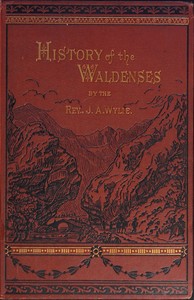
Yes. On Waldensian history, start with the "History of the Waldenses" by J.A. Wylie.

It's available a number of places including in print via Amazon, but here's an online version from Project Gutenberg:


Prof. Wylie, to make clear he was soundly Reformed, was a professor at the Free Church College in Scotland during a period when the Waldensians were sending their students to the Free Church for theological training because liberalism had gotten into the historic Reformed seminaries of Switzerland. The Free Church, at that time, was extensively involved in foreign missions and in supporting conservative Reformed movements in Europe connected with the Reveil, which might roughly be considered the European phase of the First Great Awakening.

I add that because a number of the people that have reprinted Wylie's book are NOT theologically sound. The include certain groups of Baptists who teach Baptist Successionism (the Trail of Blood people), and even more problematically, the Seventh Day Adventists. Wylie is fine. Some of the people who reprinted his book are not.

Also, Lord willing, when you start preaching through the Waldensian Catechism near the end of this year, will it be uploaded to ReformedAtFLW on facebook? I'd be interested to listen to it!

Definitely.

Lord willing, of course. This is going to be a major project and it will be, to my knowledge, the first series of Waldensian Catechism sermons ever to be preached in English, as opposed to French and Italian, which has been happening for centuries, or Spanish, which has been happening since the late 1800s when Italians moved to Argentina and Uruguay and Paraguay, and a number of Waldensian mission works began there. I am not naive about the problems I am going to face.

The Dutch Reformed practice, which I like, is to preach on Sunday mornings directly from Scripture, usually Lectio Continua (meaning verse by verse through a book) and Sunday evenings through the Heidelberg Catechism. We post our Sunday morning and Sunday evening services live each Lord's Day. That will continue when the Heidelberg series ends and the Waldensian Catechism series begins.

Note, by the way, that the Waldensian Catechism has 52 questions and answers. The Heidelberg Catechism has 52 Lord's Days though a larger number of questions. Any idea where the idea might have originated? ;-)

It might be that the Dutch and Germans are following an ancient Italian practice of catechetical preaching. It's not irrelevant that the Elector Palatine who commissioned the Heidelberg Catechism had direct contact with the Waldensians and was among the princely defenders of the Waldensians against their persecutors.

There are two problems with that theory.

One: most Waldensian churches had no preacher and were visited very irregularly -- as in perhaps once every few years -- by a traveling evangelist who, among other things, administered the Lord's Supper and did the baptisms that were needed. In between those VERY rare visits by a traveling evangelist, who was usually a traveling merchant or traveling medical doctor who used his profession as a "cover story" to justify his travels, the church used the Waldensian Catechism for laypeople to teach other laypeople under persecution. It seems to have been the foundation for what the Waldensians did during their underground church services, but we simply don't know.

Two: we have a better idea what was happening with the settled pastors of the Waldensian Valleys of what are now northwest Italy and far southeast France in the high Alps, but even there, Waldensian history from the period of persecution is extremely difficult to pin down with certainty and practices may have changed over time. After all, the three centuries from Peter Waldo's conversion in 1173 to the dawn of the Reformation are not a short period. Persecuted churches do not create written records since they could be used as evidence in prosecution. Much of what we know of Waldensian history prior to the Reformation comes from Roman Catholic and secular court records of the persecutors, or from a series of histories written by the last "barbes" (uncles, or pastors) of the Waldensians who led their people into the Reformed camp under the influence of William Farel of Geneva, and wanted to write down for posterity who the Waldensians were and what they believed. Later historians have argued that they tried to make the Waldensians look more Reformed than they were, and there is some justification for that position. However, a better argument would be that the Waldensians were like a lot of American evangelical churches that are fundamentally sound on the basics, and when introduced to the Reformed faith in a confessional form, say, "This is a better and more systematic explanation, based on chapter and verse from the Bible, of what we always believed."

Now, since you are a Baptist, I need to point something out. The Waldensian practice since the Reformation has been to practice infant baptism. What about before the Reformation?

You will note that the Waldensian catechism and confessions, even the later ones, are largely silent on the time of baptism. There is a reason for that.

The Waldensians were not Anabaptists. They did not rebaptize. That would have been a criminal offense in medieval Europe, dating back to Roman laws against the Donatists that were formalized in the Justinian Code.

What they did do, in at least some cases, was to delay baptism until profession, while recognizing the legitimacy of baptisms administered to infants. The strong preference was to wait until a traveling Waldensian evangelist could do the baptisms rather than getting a baby baptized by the local Catholic priest, but that could be years or sometimes even decades until a Waldensian preacher came to town.

This is me talking, not official Waldensian doctrine, though I'm not saying anything contradicting Waldensian history or confessional positions. I actually think the ancient pre-Reformation Waldensian practice of allowing both infant baptism and baptism following profession, but not rebaptizing infants if already baptized, is quite applicable to the modern evangelical world. It is not the Baptist position, obviously, but avoids forcing infant baptism on parents who truly do not believe it is appropriate, while saying that those who WERE baptized as infants are to be recognized as validly baptized.

That's the key problem with admitting non-Baptists to a Baptist church: if infant baptism is invalid then the people are not baptized and are in sin by refusing to be baptized. The ancient Waldensian position allows delay of baptism, but not rebaptism.

I think that position, which developed under persecution, was an acceptable solution to practical problems of the Middle Ages and is applicable today in cases of parental conscience and preference to delay baptism until profession.

It's not Dutch Reformed and I know that; the Three Forms of Unity include some REALLY strong language intended to prove to the Catholics that the Reformed were not Anabaptists. While the Presbyterians were historically more tolerant of the Baptists than the Dutch, it's also contrary to the Westminster Confession's teaching that neglect of baptism is a "great sin."

But what I'm describing has been the de facto practice of most but not all Reformed Congregational churches since the 1800s and I'm fine with it.
 
Last edited:
Quite welcome! I had a feeling this might be useful to others.


Yes. On Waldensian history, start with the "History of the Waldenses" by J.A. Wylie.

It's available a number of places including in print via Amazon, but here's an online version from Project Gutenberg:


Prof. Wylie, to make clear he was soundly Reformed, was a professor at the Free Church College in Scotland during a period when the Waldensians were sending their students to the Free Church for theological training because liberalism had gotten into the historic Reformed seminaries of Switzerland. The Free Church, at that time, was extensively involved in foreign missions and in supporting conservative Reformed movements in Europe connected with the Reveil, which might roughly be considered the European phase of the First Great Awakening.

I add that because a number of the people that have reprinted Wylie's book are NOT theologically sound. The include certain groups of Baptists who teach Baptist Successionism (the Trail of Blood people), and even more problematically, the Seventh Day Adventists. Wylie is fine. Some of the people who reprinted his book are not.


Definitely.

Lord willing, of course. This is going to be a major project and it will be, to my knowledge, the first series of Waldensian Catechism sermons ever to be preached in English, as opposed to French and Italian, which has been happening for centuries, or Spanish, which has been happening since the late 1800s when Italians moved to Argentina and Uruguay and Paraguay, and a number of Waldensian mission works began there. I am not naive about the problems I am going to face.

The Dutch Reformed practice, which I like, is to preach on Sunday mornings directly from Scripture, usually Lectio Continua (meaning verse by verse through a book) and Sunday evenings through the Heidelberg Catechism. We post our Sunday morning and Sunday evening services live each Lord's Day. That will continue when the Heidelberg series ends and the Waldensian Catechism series begins.

Note, by the way, that the Waldensian Catechism has 52 questions and answers. The Heidelberg Catechism has 52 Lord's Days though a larger number of questions. Any idea where the idea might have originated? ;-)

It might be that the Dutch and Germans are following an ancient Italian practice of catechetical preaching. It's not irrelevant that the Elector Palatine who commissioned the Heidelberg Catechism had direct contact with the Waldensians and was among the princely defenders of the Waldensians against their persecutors.

There are two problems with that theory.

One: most Waldensian churches had no preacher and were visited very irregularly -- as in perhaps once every few years -- by a traveling evangelist who, among other things, administered the Lord's Supper and did the baptisms that were needed. In between those VERY rare visits by a traveling evangelist, who was usually a traveling merchant or traveling medical doctor who used his profession as a "cover story" to justify his travels, the church used the Waldensian Catechism for laypeople to teach other laypeople under persecution. It seems to have been the foundation for what the Waldensians did during their underground church services, but we simply don't know.

Two: we have a better idea what was happening with the settled pastors of the Waldensian Valleys of what are now northwest Italy and far southeast France in the high Alps, but even there, Waldensian history from the period of persecution is extremely difficult to pin down with certainty and practices may have changed over time. After all, the three centuries from Peter Waldo's conversion in 1173 to the dawn of the Reformation are not a short period. Persecuted churches do not create written records since they could be used as evidence in prosecution. Much of what we know of Waldensian history prior to the Reformation comes from Roman Catholic and secular court records of the persecutors, or from a series of histories written by the last "barbes" (uncles, or pastors) of the Waldensians who led their people into the Reformed camp under the influence of William Farel of Geneva, and wanted to write down for posterity who the Waldensians were and what they believed. Later historians have argued that they tried to make the Waldensians look more Reformed than they were, and there is some justification for that position. However, a better argument would be that the Waldensians were like a lot of American evangelical churches that are fundamentally sound on the basics, and when introduced to the Reformed faith in a confessional form, say, "This is a better and more systematic explanation, based on chapter and verse from the Bible, of what we always believed."

Now, since you are a Baptist, I need to point something out. The Waldensian practice since the Reformation has been to practice infant baptism. What about before the Reformation?

You will note that the Waldensian catechism and confessions, even the later ones, are largely silent on the time of baptism. There is a reason for that.

The Waldensians were not Anabaptists. They did not rebaptize. That would have been a criminal offense in medieval Europe, dating back to Roman laws against the Donatists that were formalized in the Justinian Code.

What they did do, in at least some cases, was to delay baptism until profession, while recognizing the legitimacy of baptisms administered to infants. The strong preference was to wait until a traveling Waldensian evangelist could do the baptisms rather than getting a baby baptized by the local Catholic priest, but that could be years or sometimes even decades until a Waldensian preacher came to town.

This is me talking, not official Waldensian doctrine, though I'm not saying anything contradicting Waldensian history or confessional positions. I actually think the ancient pre-Reformation Waldensian practice of allowing both infant baptism and baptism following profession, but not rebaptizing infants if already baptized, is quite applicable to the modern evangelical world. It is not the Baptist position, obviously, but avoids forcing infant baptism on parents who truly do not believe it is appropriate, while saying that those who WERE baptized as infants are to be recognized as validly baptized.

That's the key problem with admitting non-Baptists to a Baptist church: if infant baptism is invalid then the people are not baptized and are in sin by refusing to be baptized. The ancient Waldensian position allows delay of baptism, but not rebaptism.

I think that position, which developed under persecution, was an acceptable solution to practical problems of the Middle Ages and is applicable today in cases of parental conscience and preference to delay baptism until profession.

It's not Dutch Reformed and I know that. It's contrary to the Westminster Confession's teaching that neglect of baptism is a "great sin."

But it has been the de facto practice of most but not all Reformed Congregational churches since the 1800s and I'm fine with it.
This is great info Darrel, thanks! I'll have to put that book by Wylie on my kindle!
 
The sonnet I'll share tonight is about the persecution of the Scottish Covenanters. It is also interestingly connected to Milton's sonnet on the Waldensians. Reading it after reading Milton's poem is a bit haunting.

PERSECUTION OF THE SCOTTISH COVENANTERS
By William Wordsworth

When Alpine Vales threw forth a suppliant cry,
The majesty of England interposed
And the sword stopped; the bleeding wounds were closed;
And Faith preserved her ancient purity.
How little boots that precedent of good,
Scorned or forgotten, Thou canst testify,
For England's shame, O Sister Realm! from wood,
Mountain, and moor, and crowded street, where lie
The headless martyrs of the Covenant,
Slain by Compatriot-protestants that draw
From councils senseless as intolerant
Their warrant. Bodies fall by wild sword-law;
But who would force the Soul, tilts with a straw
Against a Champion cased in adamant.
 
Spot on, @philomath, with regard to Wordsworth's comparisons of England coming to the aid of the "Alpine Vales" (i.e., the Waldensians) and then, after Cromwell's death, persecuting the Covenanters.

You may be aware that King Charles II took money that Cromwell had raised to help the Waldensians and gave it to his mistresses. Much later, after William and Mary took the throne, the Waldensians called this to the attention of the English Crown and to this day, the royal treasury of England still pays money to the Waldensian Synod in Italy that originated from Cromwell's fundraising. It's only a token amount now since it wasn't invested and didn't grow with interest, and inflation over the last three and a half centuries, combined with devaluation of the British Pound, has kind of been a big deal, but it was intended to be a permanent royal repentance for King Charles II's actions of stealing money intended to aid the Waldensians in Italy.

If you keep doing this reading, Philomath, I may end up having to be making a visit to West Virginia to give you ravioli and spaghetti recipes and convince the conservatives in the Italian Synod (who, by the way, include the Senate Majority Leader in Prime Minister Giorgia Meloni's conservative government in Italy) that a guy in the Appalachians has decided that he has something in common with Italian "mountain men" who fought off the persecutors for centuries.

I've been saying this joke about the Ozarks for a quarter century, and it also could apply to Appalachia:

What's the difference between Italians and hillbillies?
We dress better, and carry shorter guns we can hide better.

The sonnet I'll share tonight is about the persecution of the Scottish Covenanters. It is also interestingly connected to Milton's sonnet on the Waldensians. Reading it after reading Milton's poem is a bit haunting.

PERSECUTION OF THE SCOTTISH COVENANTERS
By William Wordsworth

When Alpine Vales threw forth a suppliant cry,
The majesty of England interposed
And the sword stopped; the bleeding wounds were closed;
And Faith preserved her ancient purity.
How little boots that precedent of good,
Scorned or forgotten, Thou canst testify,
For England's shame, O Sister Realm! from wood,
Mountain, and moor, and crowded street, where lie
The headless martyrs of the Covenant,
Slain by Compatriot-protestants that draw
From councils senseless as intolerant
Their warrant. Bodies fall by wild sword-law;
But who would force the Soul, tilts with a straw
Against a Champion cased in adamant.
 
One more item. You may be aware that Wordsworth personally visited the Alps and wrote poetry on that experience. Wordsworth was an Anglican, not a Presbyterian, but in that era that wasn't necessarily a problem for English supporters of the Waldensians. One of the key British supporters of the Waldensians after the defeat of Napoleon was Col. Charles Beckwith (later promoted to Major General), a seriously injured British soldier from the Napoleonic Wars who decided to make helping the Waldensians his life work after being medically unable to perform military duties. He tried and failed to get the Waldensians to accept Anglican bishops, but he did succeed in making British support for the Waldensians, and for Italian Protestant evangelistic efforts, a multidenominational British effort, not just a Presbyterian effort.

Here's his poem on the Waldensians:

Waldenses
by William Wordsworth

Those had given earliest notice, as the lark
Springs from the ground the morn to gratulate;
Or rather rose the day to antedate,
By striking out a solitary spark,
When all the world with midnight gloom was dark.--
Then followed the Waldensian bands, whom Hate
In vain endeavours to exterminate,
Whom Obloquy pursues with hideous bark:
But they desist not;--and the sacred fire,
Rekindled thus, from dens and savage woods
Moves, handed on with never-ceasing care,
Through courts, through camps, o'er limitary floods;
Nor lacks this sea-girt Isle a timely share
Of the new Flame, not suffered to expire.

Here is some more information on the role of Anglicans in supporting the Waldensians. CAUTION: Remember that that American Waldensian Society today is a mainline body, as is the British equivalent. Their historical work is usually accurate, but I'm not endorsing everything the organization does, or its positions today.


Last edited:
If you keep doing this reading, Philomath, I may end up having to be making a visit to West Virginia to give you ravioli and spaghetti recipes and convince the conservatives in the Italian Synod (who, by the way, include the Senate Majority Leader in Prime Minister Giorgia Meloni's conservative government in Italy) that a guy in the Appalachians has decided that he has something in common with Italian "mountain men" who fought off the persecutors for centuries.
Hahah! Sounds like a plan! :cheers:

I could set you up with some deer recipies (though I bet there's no shortage of them in The Ozarks!) and a squirrel gravy recipie to have with biscuits (that may not sound the most appetizing to folks :lol:, but it does taste good).

If you ever visit in spring, we could get you set up with a classic West Virginia cuisine: ramp pepperoni rolls.

I've been saying this joke about the Ozarks for a quarter century, and it also could apply to Appalachia:

What's the difference between Italians and hillbillies?
We dress better, and carry shorter guns we can hide better.
:lol:
 
LOL! I have a deer herd in my subdivision. Usually about 20 to 30 deer, though more now because of spotted fawns following their moms and eating their way around our lawns. They wander the neighborhood and make a lawn-eating circuit about every week or so. We should pay them to be lawnmowers. We can't shoot them inside the city limits and I think they know that and is why they stay here and not migrate out to the unincorporated areas that are -- literally -- just beyond my property line at the edge of the city.

I have had squirrel and possum served at school board meetings. No, I am not kidding. This is the Ozarks. I assume they were shot by school board members, or maybe the superintendent's secretary.

On ramp pepperoni rolls, here's a link for those who have no idea what we're talking about:


It's not well known outside Appalachia, but as you and I both know, Italian miners were brought to West Virginia by mine owners since they would work for less money and under worse conditions than Americans. Senator Joe Manchin (originally Mancini) is an example of their descendants. My own Maurina ancestors came to America as miners for that reason, though to Michigan's Upper Peninsula, not West Virginia.

So maybe my joke about starting a Waldensian mission in Appalachia actually would work!

Virtually all Italians came to West Virginia as Catholics, and while there were some Waldensian outreaches to Italian immigrant miners in Pennsylvania in the 1800s and early 1900s, I am not aware of any Waldensian missions ever getting started in West Virginia. I think the Baptists kind of run things down there in your hollers, and have for generations, ever since the Presbyterians couldn't provide ministers for the Scots Irish who settled in the hills and hollers.

I actually have the Genevan Psalter in modern Italian for any of the "old Italian" immigrants, or second-generation descendants, who still think English is a bad language for prayer and insist on using their mother tongue. But any Italian miner old enough to speak the language of the "old country" probably speaks a Sicilian or Neapolitan dialect, not modern standard Italian, which is based on the northern European literary forms of Italian, particularly Dante and his literary successors (think Dante's Inferno). Sicilian and Neapolitan Italian, particularly from the 1800s, is comparable to the difference between Spanish and Portuguese. Mutually understandable, but with difficulty.

Hahah! Sounds like a plan! :cheers:

I could set you up with some deer recipies (though I bet there's no shortage of them in The Ozarks!) and a squirrel gravy recipie to have with biscuits (that may not sound the most appetizing to folks :lol:, but it does taste good).

If you ever visit in spring, we could get you set up with a classic West Virginia cuisine: ramp pepperoni rolls.


:lol:
 
I have had squirrel and possum served at school board meetings. No, I am not kidding. This is the Ozarks. I assume they were shot by school board members, or maybe the superintendent's secretary.
That'd be quite the meeting! I've never had opossum before (America's only native marsupial!), but I bet I could find it at the annual "Roadkill Cook-Off" (sounds like a tall tale about backwater hicks, but it's a real thing. I've never been to it, but I wouldn't be opposed to trying the food as long as it's not literal roadkill :barfy:).
So maybe my joke about starting a Waldensian mission in Appalachia actually would work!
I would love to see that. I went to school with many Italians (Romanist school) growing up. There are many I know who don't really understand (or even agree with) much of what Rome teaches, but are tied to it culturally. Being able to point out the old Waldensians and Italian Reformed to them locally would be helpful.
I think the Baptists kind of run things down there in your hollers, and have for generations, ever since the Presbyterians couldn't provide ministers for the Scots Irish who settled in the hills and hollers.
There's a bit of a mix. I'd say the main groups are Baptist (IFB, Freewill, SBC, WV ABCUSA (not as liberal as the national denomination, but getting there), different flavors of Pentecostal, "Holiness" groups, Methodists, and Campbellites. Much of WV is filled with a "good ol' boy" or "pull yourself up by your bootstraps" religion. Semi-pelagianism is rampant and there's a big heap of outright pelagianism as well. Much of the religious thought here among people preofessing to be Christian is often "Me, Jesus, and my deerstand".

There is a presence of faithful reformed churches here though! Many of them can be found through the Mountain State directory of Sovereign Grace Congregations.
 
How fast the Marian death-list is unrolled!
See Latimer and Ridley in the might
Of Faith stand coupled for a common flight!
One (like those prophets whom God sent of old)
Transfigured, from this kindling hath foretold
A torch of inextinguishable light;
The Other gains a confidence as bold;
And thus they foil their enemy's despite.
The penal instruments, the shows of crime,
Are glorified while this once-mitred pair
Of saintly Friends the "murtherer's chain partake,
Corded, and burning at the social stake:"
Earth never witnessed object more sublime
In constancy, in fellowship more
what a glorious tribute to the faithfulness of these Protestant martyrs. I found this quote attributed to Latimer at the moment of their martyrdom:

“Be of good comfort, Master Ridley, and play the man! We shall this day light such a candle, by God’s grace, in England, as I trust shall never be put out.” It helped to put in to context Wordsworth line “A torch of inextinguishable light;” It is also a sad fact of history that the early church suffered the “torch-lighting” of Nero in the first century, only for the torch to be lit again in the 16th within Christendom itself. It surely is a blessing that the inter-faith violence of the religious wars has been all but extinguished.

I enjoyed the line “The penal instruments, the shows of crime, Are glorified.” Christ himself glorified the ultimate instrument of penal condemnation at the cross. The object of shame and crime becomes the symbol of Christ’s victory. So too the instruments of punishment in Latimer and Ridley’s day. Reading this sonnet provides a good opportunity to remember those suffering for Christ today.
 
Tonight I will share two sonnets by George Herbert (I never miss a chance to promote my own avatar) :lol: These will be the only two Herbert poems I share, I promise!

They are titled The Holy Scriptures I & II

I.

OH Book! infinite sweetnesse! let my heart
Suck ev’ry letter, and a hony gain,
Precious for any grief in any part;
To cleare the breast, to mollifie all pain.

Thou art all health, health thriving till it make
A full eternitie: thou art a masse
Of strange delights, where we may wish & take.
Ladies, look here; this is the thankfull glasse,

That mends the lookers eyes: this is the well
That washes what it shows. Who can indeare
Thy praise too much? thou art heav’ns Lidger here,
Working against the states of death and hell.

Thou art joyes handsell: heav’n lies flat in thee,
Subject to ev’ry mounters bended knee.


II.

OH that I knew how all thy lights combine,
And the configurations of their glorie!
Seeing not onely how each verse doth shine,
But all the constellations of the storie.

This verse marks that, and both do make a motion
Unto a third, that ten leaves off doth lie:
Then as dispersed herbs do watch a potion,
These three make up some Christians destinie:

Such are thy secrets, which my life makes good,
And comments on thee: for in ev’ry thing
Thy words do finde me out, & parallels bring,
And in another make me understood.

Starres are poore books, & oftentimes do misse:
This book of starres lights to eternall blisse.
 
what a glorious tribute to the faithfulness of these Protestant martyrs. I found this quote attributed to Latimer at the moment of their martyrdom:

“Be of good comfort, Master Ridley, and play the man! We shall this day light such a candle, by God’s grace, in England, as I trust shall never be put out.” It helped to put in to context Wordsworth line “A torch of inextinguishable light;” It is also a sad fact of history that the early church suffered the “torch-lighting” of Nero in the first century, only for the torch to be lit again in the 16th within Christendom itself. It surely is a blessing that the inter-faith violence of the religious wars has been all but extinguished.

I enjoyed the line “The penal instruments, the shows of crime, Are glorified.” Christ himself glorified the ultimate instrument of penal condemnation at the cross. The object of shame and crime becomes the symbol of Christ’s victory. So too the instruments of punishment in Latimer and Ridley’s day. Reading this sonnet provides a good opportunity to remember those suffering for Christ today.
:amen:

Well said. It's a true blessing to live in times of relative peace where the likelihood of being burned at the stake is currently slim to none.

I often remember Latimer's words! It is a good reminder to pray for England, for Gospel witness to go forth even in the face of all the troubles!
 
It's not well known outside Appalachia, but as you and I both know, Italian miners were brought to West Virginia by mine owners since they would work for less money and under worse conditions than Americans. Senator Joe Manchin (originally Mancini) is an example of their descendants. My own Maurina ancestors came to America as miners for that reason, though to Michigan's Upper Peninsula, not West Virginia.

So maybe my joke about starting a Waldensian mission in Appalachia actually would work!

Virtually all Italians came to West Virginia as Catholics, and while there were some Waldensian outreaches to Italian immigrant miners in Pennsylvania in the 1800s and early 1900s, I am not aware of any Waldensian missions ever getting started in West Virginia.

I would love to see that. I went to school with many Italians (Romanist school) growing up. There are many I know who don't really understand (or even agree with) much of what Rome teaches, but are tied to it culturally. Being able to point out the old Waldensians and Italian Reformed to them locally would be helpful.

We're on the same page. Culture counts, and the externals which are not essential to the faith DO matter in reaching people for the faith.

For example, a church reaching Hispanics needs to speak Spanish for obvious reasons, but it's more than the language. There are ways of thinking and acting that are viewed as "common sense" and "normal" in the Hispanic community that simply are NOT normal in modern American culture, and have not been for many generations.

A significant amount of what is considered "normal and common" in Hispanic culture is actually "traditional values" that modern America has thrown in the toilet -- an emphasis on extended family rather than "American individualism" is an obvious example. Conversely, there are parts of traditional Hispanic culture that are absolutely incompatible with Christian values, among them being the "Latin Lover" stereotype. Both of those are also a major part of Italian culture. I would argue that the Roman Catholic doctrine of purgatory has led to a "cheap grace" problem that produced the problematic parts of that culture, in which men think they can do horrible things and act in horrible ways as a "man's man" and then go to confession and pay off their penalty in however many centuries or millennia of Purgatory, but my Roman Catholic friends will, quite rightly so, point out that "cheap grace" and "semi-Pelagianism" and "pull yourself up by your own bootstraps" mentality is not unknown in the American Bible Belt.

If I go to an Italian or a Puerto Rican or a Mexican or a Cuban neighborhood and talk covenant theology and the importance of multigenerational Christian families and use Dutch Reformed or Scottish Presbyterian terminology, people will look at me as if I have three heads and say, "who is this strange Protestant talking strange stuff?" But I would argue that the underlying concepts of family values are actually CLOSER in those communities to Reformed doctrine than to individualistic broad American evangelicalism.

(Now before the Martinezes and Morenos of the Hispanic world tell this Maurina that Puerto Ricans and Mexicans and Cubans are VERY different -- yes, I know that. But you're all more similar to each other than any of you are to modern American culture, at least as defined by our movies and television and music and the public schools, and the same applies to "Italians" of the immigration era of the late 1800s and early 1900s when a Sicilian and Neapolitan had many differences from a Venetian or someone else from northern Italy, and the form of the spoken Italian language in the south of Italy was so different from the Roman/Lombardy form of the language as to be almost ununderstandable.)

The complication here with Italians is that Italian-Americans have been here, in most cases, since the early 1900s. The language was largely lost during World War II when people such as my father refused, as children, to learn Italian because they were being attacked at school as "Mussolini lovers" and many Italians wanted to become "200 percenter Americans." Frank Sinatra, Tony Bennett, Connie Francis and others may have had more impact in forming Italian-American culture of the postwar era than anyone back in Italy.

That is dying away with my generation and my parent's generation, EXCEPT in areas with a large ethnic Italian population where "being Italian" is a matter of community pride and often closely linked to church and community organizations.

An Italian Protestant church with an Italian pastor who actually speaks Italian, knows his culture, is a member of the Sons of Italy or another Italian American heritage group, helps organize Columbus Day parades, etc., can have real effects in an Italian-American community where the local Catholic parish probably does NOT have an Italian priest and may have trouble getting a priest at all due to the priest shortage.

In other words, being able to say, "Our Protestant church is just as Italian as your Catholic parish" can make a real difference in convincing an Italian from a culturally Catholic background to become Protestant.

It is widely understood in American evangelicalism that we don't ask a Cuban or a Mexican or a Puerto Rican to give up his culture to become Protestant. We ask him to come to Christ. And the church he joins, if in Florida, may very well be praying regularly for the overthrow of the Cuban Communists, and helping organize evangelistic work in Cuba and among Cubans.

American evangelicals of the late 1800s and early 1900s largely failed to do that with Italians and as a result largely failed to convert Italians. That didn't need to happen. Italians were viewed as the "lowest of the low" among American immigrants. Even Irish priests and parishes sometimes refused entry to Italian Catholics! An aggressive effort to convert Italians could have worked. Italians often were hated by their own co-religionists and often were pretty unhappy with the Pope during the period that the Papal States were a barrier to Italian reunification, and for decades after, the Pope was actively fighting the unified Italian government as a "Prisoner of the Vatican."

It's not as if it wasn't tried. There were once Waldensian churches in Italian communities in places like New York City (two), Chicago (two), Rochester, and the Galveston area of Texas which early on had been a major center of Italian immigration to the South. Waldensian preaching stations existed in mining regions of Pennsylvania and parts of Canada. I know of others but a lot of the records have never been translated and are filed away in the home mission files of the American Waldensian Society and of the PC(USA) denominational headquarters (which in that era was doing a lot of Italian mission work helping Waldensians).

Ironically, the only Waldensian churches that survived the post-World War II loss of the Italian language were not in traditional Italian areas, but rather in the Ozarks and in western North Carolina where the Waldensians came early, created their own communities and culture, and were **NOT** attacked as "foreign" and "anti-American" during World War II because they were the founders of the town.

Other denominations had Italian outreaches as well, but most of them suffered the same fate during and after World War II, especially as the urban "Little Italies" broke up and people moved to the suburbs and were less likely to drive into the city to attend an ethnic church in a "Little Italy" where the neighborhood was probably poor, had bad housing, and might be rapidly changing to another immigrant ethnic group.

It's pretty understandable why an Italian Protestant teenager or young adult who speaks both English and Italian might decide to join an English-speaking church in 1942. Or when he grows up and gets married, decided to marry an American girl or an American guy and join his or her church in the 1950s.

Now you have the history of a failed mission effort.


There's a bit of a mix. I'd say the main groups are Baptist (IFB, Freewill, SBC, WV ABCUSA (not as liberal as the national denomination, but getting there), different flavors of Pentecostal, "Holiness" groups, Methodists, and Campbellites. Much of WV is filled with a "good ol' boy" or "pull yourself up by your bootstraps" religion. Semi-pelagianism is rampant and there's a big heap of outright pelagianism as well. Much of the religious thought here among people preofessing to be Christian is often "Me, Jesus, and my deerstand".

There is a presence of faithful reformed churches here though! Many of them can be found through the Mountain State directory of Sovereign Grace Congregations.

You've just described the Ozarks, except that when I moved here a quarter-century ago, the Reformed faith was all but unknown. A couple of Reformed Baptist churches, three at most, in the whole region.

There are more now, and more that are loosely Reformed, but still not very many.

Now as for typical Bible Belt Baptists, I actually have run into more people in the Baptist world who know what a Waldensian is than I run into in "normal" Reformed circles. Older Baptists have been taught by the "Trail of Blood" book that Waldensians are part of the chain of "Baptist Successionism." Now I would push back on the idea that Waldensians were Baptists as a matter of history, but it is understood by a lot of older Baptists, correctly so, that Waldensians were "Protestants before Protestantism," and our history of allowing parents to delay baptism until profession, while still teaching the legitimacy of infant baptism, is actually pretty helpful here in the Bible Belt. It's close to the de facto practice of the PCA to admit Baptists to membership, and long predates the Reformation.
 
It's always worthwhile to remember this qualifier: in America, at least.
:agree:. I should probably add *and areas to that.

I was primarily thinking of burning at the stake in general as I don't know of any groups that still do that.

The fact of religious persecution and Christians being martyred is still an ever present reality.
 
Back
Top