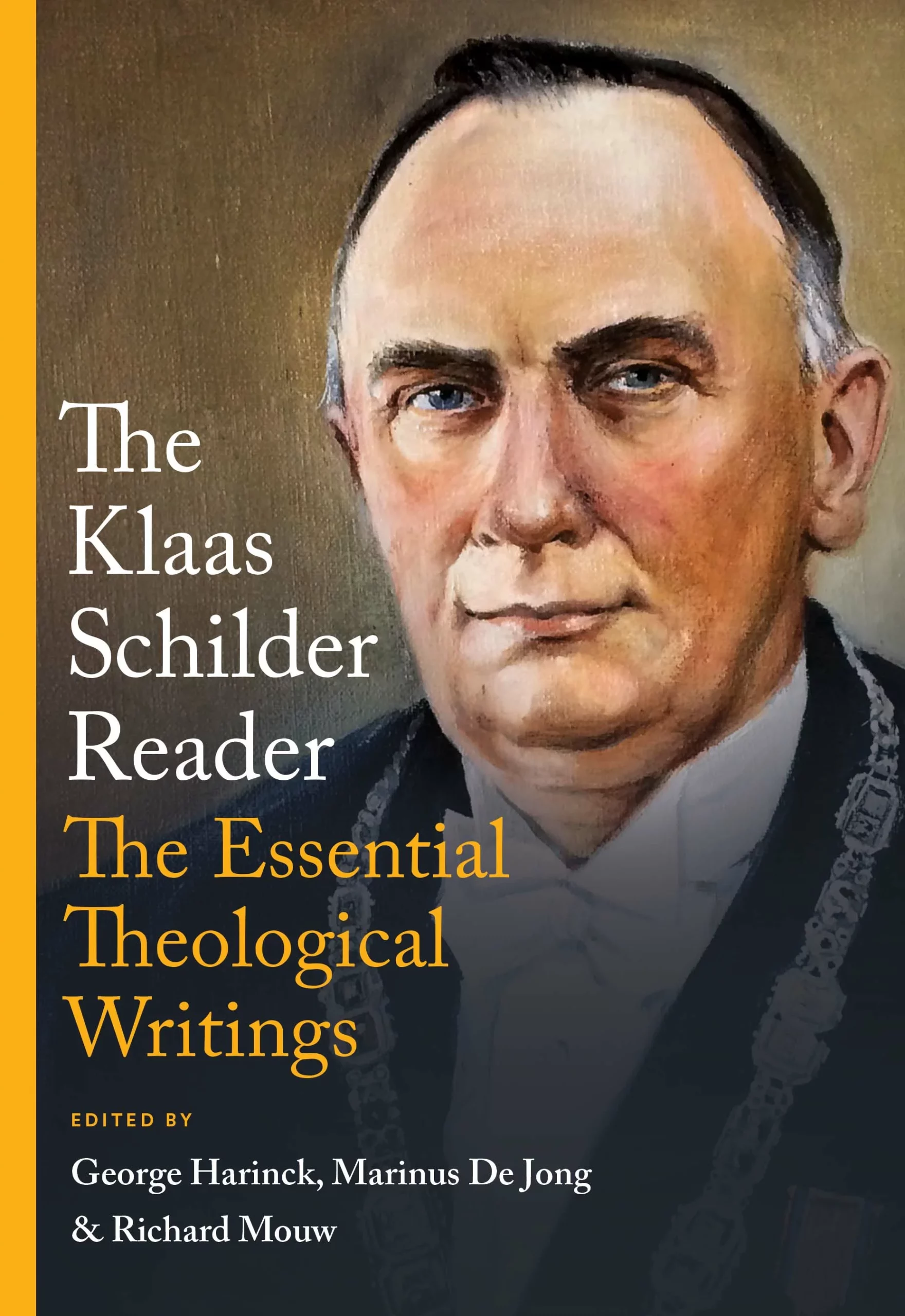
Paradox in Klaas Schilder.

Status
Not open for further replies.

jwright82

Puritan Board Professor

Interesting article on Klaas Schilder and I couldn't help but notice that it, at least formally agrees, seems like something Van Til would say. I'm reading a book on him and Dutch Reformed covenant theology and maybe Van Til wasn't so original in his formulation. For further exploration here B. A. Bosserman wrote a dissertation on this, I'm halfway through. Just food for thought.
 
Have you read John Muether's biography on Van Til? In that book Muether discusses how both Van Tils (Cornelius and his nephew Henry) were influenced by Schilder. It's not a huge portion of the book, but there are a few comments relative to Schilder and the concept of paradox. I recommend the book to anyone interested in Van Til's life and the events, people, philosophies, etc. that shaped him.
 
Interesting article on Klaas Schilder and I couldn't help but notice that it, at least formally agrees, seems like something Van Til would say. I'm reading a book on him and Dutch Reformed covenant theology and maybe Van Til wasn't so original in his formulation. For further exploration here B. A. Bosserman wrote a dissertation on this, I'm halfway through. Just food for thought.

Wes is a member here and might be able to chime in with an answer.

This idea in Schilder is highly problematic: "What I find as a paradox, so they say, God did not place there as such; rather, I have not yet discovered in his essence what he wanted me to find there. There must be unity, since both God and his work are one. When I am unable to find that unity there, this is not because of revelation but because of my reception of that revelation. (p.392)"

One will see the same jump that Van Til would make. It goes from the incomprehensible essence to the comprehensible revelation. The assumption is that revelation is revealing God Himself to us, the incomprehensible, only we are not able to comprehend it. Whereas in traditional Reformed approaches God has accommodated Himself to what we can comprehend. The revelation is comprehensible. This gives it internal consistency. Hence we make logical categories to differentiate things so as to preserve the unity in how we understand the revelation of God. E,g, three Persons, one Essence. Two Natures, one Person. These categories reflect the comprehensible unity of revelation without seeking to peer into the essence of God Himself.
 
Wes is a member here and might be able to chime in with an answer.

This idea in Schilder is highly problematic: "What I find as a paradox, so they say, God did not place there as such; rather, I have not yet discovered in his essence what he wanted me to find there. There must be unity, since both God and his work are one. When I am unable to find that unity there, this is not because of revelation but because of my reception of that revelation. (p.392)"
The book I'm reading, is from a URCNA pastor named Nathan Brummel (who's also a professor at Divine Hope Reformed Bible Seminary).
His basic thesis is basically that Herman Hoeksema and Klaas Schilder contributed to the Federal Vision and NPP.
But I wondered if perhaps Van Til's formulation isn't unique but perhaps a Dutch Reformed thing. I think the quote gives some evidence that it could be.
One will see the same jump that Van Til would make. It goes from the incomprehensible essence to the comprehensible revelation. The assumption is that revelation is revealing God Himself to us, the incomprehensible, only we are not able to comprehend it. Whereas in traditional Reformed approaches God has accommodated Himself to what we can comprehend. The revelation is comprehensible. This gives it internal consistency. Hence we make logical categories to differentiate things so as to preserve the unity in how we understand the revelation of God. E,g, three Persons, one Essence. Two Natures, one Person. These categories reflect the comprehensible unity of revelation without seeking to peer into the essence of God Himself.
I'll leave it to Bosserman to argue this point, working my way through that book too.
What I would contribute, as a lay philosopher, is that Van Til's formulation isn't unique to theology at all.
In math and physics there's an interesting area of study in paradoxes, or conceptual limits that we can not answer nor move beyond. And yet we know they're true but we can never prove it, or in physics we can know one thing about something but never the other thing at the same time. Limits to our conceptual knowledge.
I think that personally the greatest advances in the 20th century was learning what we could never in principle know as humans.
I've even seen legal arguments that prove it's impossible to design a system of law that could never legally develop into a dictatorship from a democracy, it's impossible.
Logic as well. It's a Modernist dream that we can have a perfect system of logic that can answer every question. Nope it can never exist. I was obsessed with this field of study for years starting at age 17, turning 44 on June 6th actually (so a long time of study for an obsession).
So I think we disagree here about some peripheral issues but we agree on the core issues, but I must confess I don't have my thoughts worked out in a way that I'm comfortable defending them. I merely wanted to raise the question that maybe Van Til isn't that original.
 
The book I'm reading, is from a URCNA pastor named Nathan Brummel (who's also a professor at Divine Hope Reformed Bible Seminary).
His basic thesis is basically that Herman Hoeksema and Klaas Schilder contributed to the Federal Vision and NPP.
But I wondered if perhaps Van Til's formulation isn't unique but perhaps a Dutch Reformed thing. I think the quote gives some evidence that it could be.

I am always open to investigate the history, but as far as I am aware Hoeksema had his own reaction to Schilder and tried to develop the covenant idea in a different direction that was trying to clean up some of the mess that would later lead to Federal Vision type thinking. And so the Protestant Reformed like Engelsma are dead against it and would use Hoeksema to do so. They tend to run in a very different direction to historical Presbyterianism on this.

I'll leave it to Bosserman to argue this point, working my way through that book too.
What I would contribute, as a lay philosopher, is that Van Til's formulation isn't unique to theology at all.
In math and physics there's an interesting area of study in paradoxes, or conceptual limits that we can not answer nor move beyond. And yet we know they're true but we can never prove it, or in physics we can know one thing about something but never the other thing at the same time. Limits to our conceptual knowledge.
I think that personally the greatest advances in the 20th century was learning what we could never in principle know as humans.
I've even seen legal arguments that prove it's impossible to design a system of law that could never legally develop into a dictatorship from a democracy, it's impossible.
Logic as well. It's a Modernist dream that we can have a perfect system of logic that can answer every question. Nope it can never exist. I was obsessed with this field of study for years starting at age 17, turning 44 on June 6th actually (so a long time of study for an obsession).
So I think we disagree here about some peripheral issues but we agree on the core issues, but I must confess I don't have my thoughts worked out in a way that I'm comfortable defending them. I merely wanted to raise the question that maybe Van Til isn't that original.

That is interesting. It sounds like each field of discipline runs up against its own limitations and finds that what it accepts as "knowledge" is symbolic in some sense of a greater reality that lies outside itself. That would be in keeping with the Reformed doctrine of creation as a voluntary divine work which has no necessity in itself but still bears the Creator's marks of order imprinted on it.
 
I am always open to investigate the history, but as far as I am aware Hoeksema had his own reaction to Schilder and tried to develop the covenant idea in a different direction that was trying to clean up some of the mess that would later lead to Federal Vision type thinking. And so the Protestant Reformed like Engelsma are dead against it and would use Hoeksema to do so. They tend to run in a very different direction to historical Presbyterianism on this.
No I miswrote Hoeksema rejected Schilder's covenant theology. But the book is like a D. G. Hart book where each chapter is disparate until the end when Hart weaves it all together.
This book is like that because there's a lot of threads to bring together but since I already know the connection between Schilder and the FV and NPP, I can see where's he's going but someone not familiar with that would be lost.
A benefit of the book is he'll print a whole sermon of like Schilder or Hoeksema and then give an analysis of it in the next chapter. It's a very detailed amount of evidence to go into but without the overall story of Schilder and those aberrant theologies, the average readers will get lost.
I'll post a link to the book for everyone.
That is interesting. It sounds like each field of discipline runs up against its own limitations and finds that what it accepts as "knowledge" is symbolic in some sense of a greater reality that lies outside itself. That would be in keeping with the Reformed doctrine of creation as a voluntary divine work which has no necessity in itself but still bears the Creator's marks of order imprinted on it.
That's basically it but for each case a complicated story would have to be argued for to connect the dots. It's interesting how I got into it.
I started out being bored with school for most of my education and making barely passable grades. My friend got me into relativity theory and quantum mechanics and I just absorbed as much knowledge as I could, so by 17 I was obsessed with this subject.
My senior math teacher, I had retake algebra two because I failed it in the previous year but I had extra credits to move on, really helped. I started going to him, he was an old man then, with my questions about advanced math problems and he made a deal with me early on.
He said "if you do all your homework and pass the tests, then I'll take the time during or after school to answer your questions". So I did and I would stay late and learn all this stuff and do my work. I would finish the tests before anyone and then start working on my own problems and ask him questions during class, I'd go up there so as not to bother anyone else. And he obliged.
But you're right, it's kinda the archetype/ectype distinction, on some level. But it ought to teach us humility and submission to the Lord that some things we'll never fully understand.
[automerge]1779331935[/automerge]

Here's the book.
 
Status
Not open for further replies.
Back
Top