Scriptural Refutation Against Some Hyperdispensationalism Points

Status
Not open for further replies.

bigsisfarmer

Puritan Board Freshman
I recently had a debate with who I now know is a hyper-dispensationalist. While I know that many of his claims are contrary to Scripture, I do need help in articulating many points. This discussion did lead him to rejecting the Church is a bride of Christ, rather than him admitting a contradiction in his points. So especially after seeing his blatant rejection of Scripture, my point in discussion is not for him to convert to Covenant Theology, but rather for me to better refine my points and how I articulate them.

List of points:

1. (The biggest issue) He claimed that the Law will be reinstated for the same reasons that they were in the Old Testament. I did point to Hebrews in how Christ was the end to the Law, and made the Law obsolete, but this was ignored. I would like to bring up something that Paul said, as this seems the only thing he will listen to.

2. The promise to Abraham had/has a physical and spiritual distinction. We share in (some) of the spiritual part of the blessing (namely Christ and eternal life), but not at all in the physical promises. This ended up in me reading out Galatians 3 & 4, Romans 4 & 9 each time he made that point. He kept trying to claim that I was "reading Paul too much into the Old Testament."

3. That the church is a break in the prophetic narrative of Israel. I didn't even know how to approach this one at all. I brought up that the 7 churches in Revelation are Gentile, briefly the sacraments (it was ignored), and the chiastic point in Leviticus. I'm not even sure if those were good points. He kept bringing up how Paul says it was a "mystery and not revealed" therefore it couldn't have existed in the OT.

4. That Christ only went to Israel. I mentioned the woman at the well, and the 7 legions. He kept trying to claim that Christ ONLY came for Israel, and that Gentiles were not included at all until Paul (citing that He only responded to Gentiles coming to Him and never went to Gentiles). He kept quoting Matthew 15:24. I honestly wasn't sure how to respond to be honest.

5. He kept on avoiding how those in the OT were saved by Christ. He first claimed that they were not saved until Christ came (which I called heresy, pointed to Hebrews, and he backed off on), but he kept on trying to avoid how they were saved by their faith in Christ. His point was that they had faith and obedience where we have no requirement for obedience. I pointed our Romans (shall we keep on sinning?), James, and how Paul instructed us to cast out anyone from the Church if they are in continual sin. Hence implying that we are required to obey (as a fruit of faith) which is the same for the OT. I still feel like I could have articulated that better.

Any help, or reading would be much appreciated. I am still very much growing in my Biblical literacy, and can use all the help I can get.
 
I did point to Hebrews in how Christ was the end to the Law, and made the Law obsolete, but this was ignored.
Right there. Some dispensationalists can be talked to. But someone who is simply going to ignore things... that person isn't really someone with whom you have a discussion of this sort.
 
Right there. Some dispensationalists can be talked to. But someone who is simply going to ignore things... that person isn't really someone with whom you have a discussion of this sort.
Completely agree! Hence why my goal isn't to convince him, but rather to grow in my understanding and articulation. I still want to be able to respond to his points in a better way.
 
First, I want to make clear, in light of everything I'm about to say, it seems this person you talked to has some frightening heresy's they hold to, and overall, you viewpoint is biblical. I grew up dispensational. I am covenantal reformed Baptist now.


1.
> He claimed that the Law will be reinstated for the same reasons that they were in the Old Testament. I did point to Hebrews in how Christ was the end to the Law, and made the Law obsolete

I think, here some definitions of terms would be helpful. What do you mean by "law". If you refer to the sacrificial system, and the clean/unclean scenario, I agree.

Much more importantly , I would want to know exactly what you mean by obsolete. My pause with this would mostly be in light of the following passages:

Matthew 5:17-18:

"Do not think that I have come to abolish the Law or the Prophets; I have not come to abolish them but to fulfill them. For truly, I say to you, until heaven and earth pass away, not an iota, not a dot, will pass from the Law until all is accomplished."

Romans 3:31:
"Do we then overthrow the law by this faith? By no means! On the contrary, we uphold the law."


As far as answering his statement "the Law will be reinstated for the same reasons that they were in the Old Testament" I would really need to know what he was basing it off of. One key component of logical debate is, you need to be able to tear down the points of the other party, not simply set forth your own. So... I guess I don't know on what basis he'd be make these points.

2.
Again, I don't know on what he was basing his claims. The scriptures are clear, we are not "step children" we are fully children of Israel, the true Israelites.

3.
I don't quite know what you are saying his claim was for this one. Was he saying that the gentile church is just kind of a pause, and then Israel will become front and center again?

4.
> That Christ only went to Israel.
We'd need a little definition of terms here. What do we mean by "went" are we speaking of whom his reached in his lifetime? If that is so, he certainly "went" to both Jews and gentiles. If we are speaking of whom he intentionally ministered to, then yes, as far as we know he only "went" to the Jewish nation.

> He kept trying to claim that Christ ONLY came for Israel

Okay, key difference here. The words "for" and "to". If Christ only came to earth "for" Israel, then, unless that guy is Jewish, he's in big trouble! The cross has no meaning for gentiles.

Clearly this is contradicted in the new Testament. Multiple times we hear of the gentiles having faith, and Christ acknowledging, and marveling at their faith. If Christ did not come for them, then on what was their faith founded? If they had unfounded faith, would the LORD praise it?

> Gentiles were not included at all until Paul

This would certainly be inaccurate. In Acts 10, we see that Peter was the first we know of to actively go to the gentiles.

5.
> He kept on avoiding how those in the OT were saved by Christ.
Yikes! That's a scatry place to go. Either, he doesn't believe atonement is the only way to have sins, and their consequences cleansed, or he believes that someone inside of Adam can live a sinless life (that would directly contradict Psalm 14, and consequentially Romans 3)

> His point was that they had faith and obedience where we have no requirement for obedience.
Hmmm, I've heard this grain of thinking before. Ya, you did well to go to James 2. No place clearer. Faith is incomplete, and dead without works. And works flow from faith. If we have faith that Christ is LORD, then we will live like it.

I know that was a lot Kiersten, I hope at least some of it helped. Wish I could give more insight! Would be glad to discuss it more in public, or in the PMs.
 
Thank you so much for your response! I really appreciate it. I am very open to discussing in the PMs, but I will clarify the points that I can here first.

I think, here some definitions of terms would be helpful. What do you mean by "law". If you refer to the sacrificial system, and the clean/unclean scenario, I agree.

By law, he meant the entire Mosaic covenant. I can only assume that he meant the OT sacraments as well, although we did not directly discuss that. I did bring up how we have no need for the bloody sacraments of the OT, now that Christ's blood has been shed we now are given bloodless sacraments.

He didn't really provide much basis for this, only claimed it.

By "obsolete" I am referring to Hebrews 8:13. The word obsolete speaks of things worn out by time and use. Earlier it says that if the Law had been without fault, there would have been no need for the new. Hebrews 9 talk about how the Law was meant to be a copy of spiritual truths. Now that Christ is here, we have no need for a copy.

Again, I don't know on what he was basing his claims. The scriptures are clear, we are not "step children" we are fully children of Israel, the true Israelites.

This was quite confusing for me too. Every time I would bring up Paul, he would say that Paul was only referring to the Spiritual promise. He was claiming that the promise to Abraham's Seed (singular Christ) was completely distinct and separate from the physical promises to Abraham (a land to his descendants). I wasn't really sure how to respond to this. (He even kept trying to accuse me of eisegesis!)
3. I don't quite know what you are saying his claim was for this one. Was he saying that the gentile church is just kind of a pause, and then Israel will become front and center again?

Yes, he was saying that the Gentile church is a pause in the prophetic narrative in Israel. Then in the events of Revelation, Israel will become front and center, and it is a continuation in the prophetic narrative.
We'd need a little definition of terms here. What do we mean by "went" are we speaking of whom his reached in his lifetime? If that is so, he certainly "went" to both Jews and gentiles. If we are speaking of whom he intentionally ministered to, then yes, as far as we know he only "went" to the Jewish nation.

He said that Jesus' ministry was to the Jewish nation. Hence the gospels are not for us. Basically everything Jesus said is not applicable to the Gentiles.


Your questions regarding this REALLY helped me! I'll definitely have to ask him that.

This would certainly be inaccurate. In Acts 10, we see that Peter was the first we know of to actively go to the gentiles.

This is extremely helpful, I did not know that Peter went to the gentiles. He claimed that Paul was the only apostle who went to the Gentiles (and claimed that Paul was entirely separate from the twelve). This will be a very good point to bring up.

Overall this was really helpful! It does encourage me a bit that I am not the only one who is scratching my head at what this guy means. Looks like I need to ask more questions, have him define more things, and make him try to back up his claims next time.
 
Welcome both new members. I think he's the one engaged in eisegesis. You can't get very far with someone who wants to set all the rules upfront and then base your arguments on those rules. The rules make that impossible, that's why they set them that way.
Vern Poythress has a book called "Understanding Dispensationalism" that's free , I believe, on his website with John Frame.
 
By law, he meant the entire Mosaic covenant.
Also, I think there is some confusion of terms here. The mosaic law, and the mosaic covenant are separate. The mosaic covenant is obselelte. The mosaic law, is not.
The two seem to be mixed here:

>By "obsolete" I am referring to Hebrews 8:13. The word obsolete speaks of things worn out by time and use. Earlier it says that if the Law had been without fault, there would have been no need for the new.
 
1730641523970.jpeg

Me trying to reconcile dispensationalism Post Millennialism with scripture,
 
To add a couple of comments to the above responses,

1. Galatians 5:6

2. If they won’t listen to Paul taking about Abraham in Romans 4 (probably because Abraham was before Sinai), look at David who failed to keep a law of works and yet who would dare to question whether David is with God now? In David’s repentance what did appeal ultimately appeal to for the forgiveness of his sins? (Psalm 51:1, Psalm 51:16)

4. Encourage him to continue reading in Matthew 15 (verse 28). See also Matthew 28:19.

5. Hebrews 11

I also recommend this article by Dr Duguid on the fulfilment of the true Israel of God - https://www.ligonier.org/learn/arti...N4xR7BGDG9ZmyL6IzSPtp0J4b9d3BFDLQc9rDhB0ogXBM

The dispensationalism system is difficult to unentangle oneself from. Patience and grace is needed. If they won’t hear you, you’ll likely have to leave them alone, but if they are seriously seeking truth don’t let them escape from the good points you have already brought up.
 
Last edited:
They are bewitched. Gal 3:1. They are under a spell. It is Satanic. You have to have the conversations, and be ready to make a defense of the gospel as you are trying to do well, but, much prayer is needed.
Its tough. I know many of them. At this point I wonder if they can even be open to truth until a few nukes go off in the USA, or something equally horrible, and they are not raptured yet.

I hope and pray neither meme I made offended anyone. If they did, I’ll delete them.
They were great!!!
 
Thank you!

I'm glad it was of some help Kiersten! So, what would be some points you would like to explore further from here? What are the places that would be most unresolved?

The main thing I am still struggling with is how to refute the "church being a prophetic break." I am thinking that I could use Hosea.
 
The main thing I am still struggling with is how to refute the "church being a prophetic break." I am thinking that I could use Hosea.
The fact is, unless the other fellow can bring some scriptural proof to the table, you don't really need to refute it in any way except simply asking him to prove it with scripture.
 
The dispensationalism system is difficult to unentangle oneself from. Patience and grace is needed. If they won’t hear you, you’ll likely have to leave them alone, but if they are seriously seeking truth don’t let them escape from the good points you have already brought up.

It was encouraging that after this discussion, that he kept insisting on how much he loved it. He also asked to have another discussion in the future. This gave me a little bit of hope. I am hoping that some of the points I brought up at least make him study the Word more.
 
It was encouraging that after this discussion, that he kept insisting on how much he loved it. He also asked to have another discussion in the future. This gave me a little bit of hope. I am hoping that some of the points I brought up at least make him study the Word more.
Hmmm. How would you like us to pray about this?
 
The fact is, unless the other fellow can bring some scriptural proof to the table, you don't really need to refute it in any way except simply asking him to prove it with scripture.
This is a really good point, and one I need to keep remembering. I am quick to jump onto anything that contradicts Scripture (which can be good in it's own way), but I need to learn to sometimes let people dig their own hole before showing them the ladder.
 
This is a really good point, and one I need to keep remembering. I am quick to jump onto anything that contradicts Scripture (which can be good in it's own way), but I need to learn to sometimes let people dig their own hole before showing them the ladder.
Very well said! If someone can't bring any proof to the table, you don't really have anything to disprove.
 
Hmmm. How would you like us to pray about this?

That ultimately he would be drawn to study the Word more through our discussions. I don't really think it matters if he continues to hold to dispensationalism, but I hope the Lord opens his eyes to some of the heresies he believes.

And prayer for me to be patient, and for the Lord to bring to mind the right words to say.
 
That ultimately he would be drawn to study the Word more through our discussions. I don't really think it matters if he continues to hold to dispensationalism, but I hope the Lord opens his eyes to some of the heresies he believes.

And prayer for me to be patient, and for the Lord to bring to mind the right words to say.
I will pray about this! May you ask for the wisdom we all lack, and all are freely allowed to ask for, and receive as per James 1!
 
The main thing I am still struggling with is how to refute the "church being a prophetic break." I am thinking that I could use Hosea.
I believe it is in First Peter that the Church in various parts of Anatolia is called a chosen people, peculiar nation, kingdom of priests ext. You have the promise of all nations being blessed in Genesis, and the prophecies on the ingathering of the gentiles throughout the prophets. Issiah 53-54 for example, somewhere in Zechariah, and about half the psalter. Romans 11 says that the salvation of the Jews will be of value to the rest. I can probably type out more examples and more precise references later.

And chances are the way apostles use scripture is an unanswered question floating in his head if he read the new testament enough. Perhaps try to show that you can consistently defend it from the OT passages, and how that logic applies to the rest of the old testament. But I need to get back to work in a moment
 
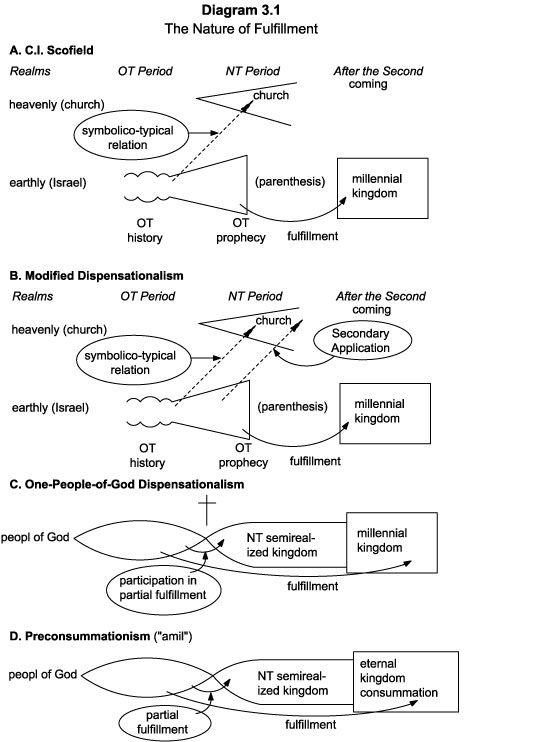
The missing piece in the Dispensationalist's thinking is Jesus. They think Reformed Theology (aka "replacement theology") teaches that the church replaces Israel, thus falsifying God's promises to Israel. I can see why they find that idea problematic - but it isn't what Reformed Theology (or the Bible) teaches: rather, Jesus Christ has come as the new Israel to fulfill all of God's original purposes for Israel. He is the vine (a regular OT image for Israel) and now Jews and Gentiles become part of the true Israel not by heredity but through faith in Christ. As we are grafted into him by faith, both Jews and Gentiles become part of the Israel of God on precisely the same terms. This is why the old distinguishing marks of Israel (circumcision and kosher food) have been done away with once and for all, as the line between Israel and the nations has been permanently erased.
 
Status
Not open for further replies.
Back
Top