

Which Original Language should I study?

Status
Not open for further replies.
Once you have done the former, you have essentially done the latter. :book2:

Absolutely. And, not to denigrate the NT, but the NT is not the only thing worth reading in Greek. Just think of reading Homer, Plato, Aristotle, Herodotus, Hesiod, Thucydides, Aristophanes, Aeschylus, and Sophocles in the original language! For this purpose, the absolute best learning book for classical Greek is Anne Groton's book _From Alpha to Omega_.

I wish there was an "I disagree" smile here ;) (well, excluding the LXX of course).

Interesting, since of course Calvin and the Reformers (and the Church Fathers and Puritans) would disagree with you.
 
Absolutely. And, not to denigrate the NT, but the NT is not the only thing worth reading in Greek. Just think of reading Homer, Plato, Aristotle, Herodotus, Hesiod, Thucydides, Aristophanes, Aeschylus, and Sophocles in the original language! For this purpose, the absolute best learning book for classical Greek is Anne Groton's book _From Alpha to Omega_.

I wish there was an "I disagree" smile here ;) (well, excluding the LXX of course).

Interesting, since of course Calvin and the Reformers (and the Church Fathers and Puritans) would disagree with you.

I can't say I'm too worried about that. I don't think reading Plato et al did them much good (Col. 2:8).

I wonder if those who advocate reading stuff by the likes of Plato and Aristotle would tell us to read things by modern homosexuals?
 
I wish there was an "I disagree" smile here ;) (well, excluding the LXX of course).

Interesting, since of course Calvin and the Reformers (and the Church Fathers and Puritans) would disagree with you.

I can't say I'm too worried about that. I don't think reading Plato et al did them much good (Col. 2:8).

I wonder if those who advocate reading stuff by the likes of Plato and Aristotle would tell us to read things by modern homosexuals?

Yes. It helps us to understand the sinful mind, and to find opportunities for the gospel. Obviously the Apostle Paul disagreed with you as well - using Greek poets for apologetical purposes.
 
Once you have done the former, you have essentially done the latter. :book2:

Absolutely. And, not to denigrate the NT, but the NT is not the only thing worth reading in Greek. Just think of reading Homer, Plato, Aristotle, Herodotus, Hesiod, Thucydides, Aristophanes, Aeschylus, and Sophocles in the original language! For this purpose, the absolute best learning book for classical Greek is Anne Groton's book _From Alpha to Omega_.

Counting both college and seminary, I have had well over 35 hours in Koine Greek and continue to read my Greek NT. How hard would it be to learn Attic greek?

Well, it's the same language. The best analogy I can think of is that it is like going from normal everyday conversation to reading Shakespeare. If you know your English well, it's not too bad of a leap. Koine is everyday conversation style. Classical is highly stylized, with much longer sentences, as a general rule, many more verb forms, and many more subordinate clauses, and many more particles (that are always important!).
 
Interesting, since of course Calvin and the Reformers (and the Church Fathers and Puritans) would disagree with you.

I can't say I'm too worried about that. I don't think reading Plato et al did them much good (Col. 2:8).

I wonder if those who advocate reading stuff by the likes of Plato and Aristotle would tell us to read things by modern homosexuals?

Yes. It helps us to understand the sinful mind, and to find opportunities for the gospel. Obviously the Apostle Paul disagreed with you as well - using Greek poets for apologetical purposes.

And, not everthing they said was wrong, either. But you cannot understand philosophy at all, for instance, without knowing what Plato and Aristotle said. I believe it was Whitehead who said that all philosophy is a series of footnotes to Plato and Aristotle. Given that philosophy is a handmaid to theology, I think that fairly sums up their importance. Besides the Colossians passage is not directed against all philosophy, but only against sophistic philosophy.
 
Interesting, since of course Calvin and the Reformers (and the Church Fathers and Puritans) would disagree with you.

I can't say I'm too worried about that. I don't think reading Plato et al did them much good (Col. 2:8).

I wonder if those who advocate reading stuff by the likes of Plato and Aristotle would tell us to read things by modern homosexuals?

Yes. It helps us to understand the sinful mind, and to find opportunities for the gospel. Obviously the Apostle Paul disagreed with you as well - using Greek poets for apologetical purposes.

There is a difference with a quote or two for apologetic purposes and indoctrination in their writings. Moreover, Paul only quoted them when they agreed with his worldview, the effects of Greek philosophy on the Christian faith have been truly baneful.
 
Not as easy as going from Attic to Koine, but Koine is a pretty big help. There are more forms in Attic that are not used in Koine (more subjunctive and optative, for example) but the basics are all the same.

It is certainly worth the effort.

Sorry, Fred. Didn't see this comment before I commented!
 
I can't say I'm too worried about that. I don't think reading Plato et al did them much good (Col. 2:8).

I wonder if those who advocate reading stuff by the likes of Plato and Aristotle would tell us to read things by modern homosexuals?

Yes. It helps us to understand the sinful mind, and to find opportunities for the gospel. Obviously the Apostle Paul disagreed with you as well - using Greek poets for apologetical purposes.

And, not everthing they said was wrong, either. But you cannot understand philosophy at all, for instance, without knowing what Plato and Aristotle said. I believe it was Whitehead who said that all philosophy is a series of footnotes to Plato and Aristotle. Given that philosophy is a handmaid to theology, I think that fairly sums up their importance. Besides the Colossians passage is not directed against all philosophy, but only against sophistic philosophy.

Well, I might concede that those who have been throughly grounded in a Christian worldview may read it in order to critique it, but you would need to be extremely careful.
 
I wish there was an "I disagree" smile here ;) (well, excluding the LXX of course).

Interesting, since of course Calvin and the Reformers (and the Church Fathers and Puritans) would disagree with you.
I can't say I'm too worried about that. I don't think reading Plato et al did them much good (Col. 2:8).

Would you say that reading Plato, et al for his doctorate in philosophy did Bahnsen much good?
 
Interesting, since of course Calvin and the Reformers (and the Church Fathers and Puritans) would disagree with you.

I can't say I'm too worried about that. I don't think reading Plato et al did them much good (Col. 2:8).

Would you say that reading Plato, et al for his doctorate in philosophy did Bahnsen much good?

More Wittgenstein that Plato. See Bahnsen's lectures on Plato for the final scoop. As to Plato's importance, yes and no. I really think The Republic is overrated. Worse, the dualism Plato made is antithetical to biblical creationism.

Soma sema, anybody?

But on the other hand, you can't really understand Augustine, Aquinas, and Anselm without Plato.
 
That's how I found it also.

Granted I am at the beginning of my studies but even learning how to differentiate between the dagesh lene and dagesh forte and between the silent sheva and vocal sheva is enjoyable.

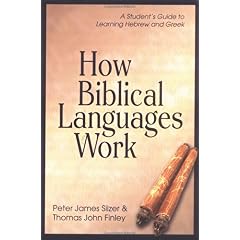
For those who may be interested; if you read this before embarking on studying Hebrew or Greek you will be greatly helped :up:

513PZZFJJGL._OU01_AA240_SH20_.jpg
 
Should I wait to study Greek if I am still studying Latin? By the end of the school year I will have had 2yrs of Latin. I will continue to study Latin, but I want to study Greek next year or over the summer.
 
Classical (Attic) Greek, then Koine Greek. :2cents:

Once you have done the former, you have essentially done the latter. :book2:

Exactly! I would rather go from Attic to Koine than vice versa.

Should I wait to study Greek if I am still studying Latin? By the end of the school year I will have had 2yrs of Latin. I will continue to study Latin, but I want to study Greek next year or over the summer.

How much Latin have you made it through in 2 years?
 
I didn't see anybody mention Aramaic. You'll miss out on half of the Book of Daniel without it!

Aramaic is basically Hebrew with an attitude, as one of my professors put it. Aramaic is not hard once you have Hebrew.

Well - it's fun to translate Greek back into Aramaic, too, especially since our LORD spoke in Aramaic (see, e.g. Matthew Black). I studied Aramaic at university, incl. Targums. I found it enriching.
 
Classical (Attic) Greek, then Koine Greek. :2cents:

Once you have done the former, you have essentially done the latter. :book2:

Exactly! I would rather go from Attic to Koine than vice versa.

Should I wait to study Greek if I am still studying Latin? By the end of the school year I will have had 2yrs of Latin. I will continue to study Latin, but I want to study Greek next year or over the summer.

How much Latin have you made it through in 2 years?

So far I have learned all the cases, 1st-3rd noun declensions, learned imperative mood recently, 3 of the 4 verb conjugations present, future, & perfect tense, lots of translation, just started reverse translation of English into Latin. I am not sure what the rest of the year will hold. I am taking it with my kids so I have no idea how fast or not fast we are going compared to a college Latin course.
 
hmm :gpl: Original Language? Well, we all know that Adam and Eve spoke Hebrew. Ha Ha. I couldn't resist.
 
Once you have done the former, you have essentially done the latter. :book2:

Exactly! I would rather go from Attic to Koine than vice versa.

Should I wait to study Greek if I am still studying Latin? By the end of the school year I will have had 2yrs of Latin. I will continue to study Latin, but I want to study Greek next year or over the summer.

How much Latin have you made it through in 2 years?

So far I have learned all the cases, 1st-3rd noun declensions, learned imperative mood recently, 3 of the 4 verb conjugations present, future, & perfect tense, lots of translation, just started reverse translation of English into Latin. I am not sure what the rest of the year will hold. I am taking it with my kids so I have no idea how fast or not fast we are going compared to a college Latin course.

Almost all of the grammar required to read most texts is covered during the first year of college instruction, but one obviously wouldn't do so much so quickly when studying at home with children. It sounds like you're doing really well. I don't imagine that there would be any reason not to go ahead and begin Greek studies. :2cents:
 
Status
Not open for further replies.
Back
Top