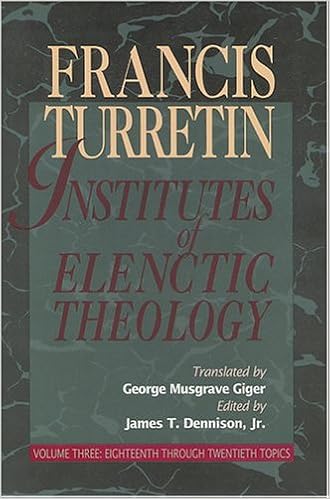
This isn't the best example since it has been awhile since I engaged with Turretin but this might help what I mean: (Third Topic, Ninth Question)
Example 1:
"Three modes of being in a place are commonly held: (1) circumscriptively—attributed to bodies because they are in place and space so as to be commensurate with parts of space; (2) definitively—applicable to created spirits and incorporeal substances (which are defined by certain places, and are so here as not to be anywhere else); (3) repletively—which is ascribed to God because his immense essence is present with all and, as it were, completely fills all places. But although this distinction (when cut to the quick) may be inaccurate and repletion may seem to belong properly to a body occupying place by its extension, yet since it has been by long use received among philosophers and theologians (and can take appropriate sense according to the mind of the Holy Spirit himself, who testifies that “God fills heaven and earth,” Jer. 23:24), it ought not to be rashly rejected (if skillfully explained and understood in a sound sense, especially since we have no proper and accurate terms for explaining the ubiquity of God and are compelled here to use phrases borrowed from finite and corporeal things).
Francis Turretin, Institutes of Elenctic Theology, ed. James T. Dennison Jr., trans. George Musgrave Giger, vol. 1 (Phillipsburg, NJ: P&R Publishing, 1992–1997), 197."
The terms circumscriptively, definitively, and repletively are not ones I have come across. I understand he gives definitions of a sort but are these typical philosophical terms?
Example 2:
XIV. All perfections belong to God, either formally (as perfections simply such, i.e., which absolutely speaking it is better to have than not to have, and than which no greater perfection can be conceived); or eminently (as perfections relatively, which indeed in their kind indicate some perfection, but necessarily conjoined with some imperfection; and because it cannot have them properly and formally, yet is said to possess them virtually and eminently because it can produce that perfection or because it can perform without it whatever that can perform, all imperfection being excluded).
Francis Turretin, Institutes of Elenctic Theology, ed. James T. Dennison Jr., trans. George Musgrave Giger, vol. 1 (Phillipsburg, NJ: P&R Publishing, 1992–1997), 196.
Terms - formally, eminently, properly, virtually
I think those examples suffice to show where I typically get lost.